My Pantry

Typically Indian kitchens (though in India and else where in other countries) are the most crowded part of the house. Mine was no exception. I started out with one suitcase full of cookware and things and ended up filling shelves after shelves of things and food. This post is focusing on pantry and Ingredients.

Cooking Indian food from scratch is an elaborate affair. Typical recipes require upwards of 15 ingredients. Initially when I began cooking regularly, it was daunting to make grocery list, plan and shop. But it fell into place after a while. Then came the over drive.  Being a foodie, I wanted to try new cuisines experiment with my recipes therefore ended up shopping for new ingredients from all corners of the world. Initially I did not realize how problematic it was. For instance, getting carried away by Quinoa, I got a bag of Quinoa a couple of years ago. It took me years to get done with the bag. In the United States, it is very difficult to find smaller bags of ingredients. Packages seemed to grow bigger and bigger. Had I got a small bag say a few Oz of Quinoa instead of the 2 lb bag that I always found in stores, I would not have been sitting on my shelf for two years. My list of similar experience include Bonito flakes, Nori, Craisens (thankfully almost done with this one), Peanut butter, oats, cereal etc. Since I regularly shop at Costco, my little boy ends up liking one or the other eatable he gets to try there and a huge bag follows us home! After eating it twice, the novelty wears out and he refuses to finish the whole bag. And there I am left with something I do not want to eat, so does anyone else at home. Also I realized that I was mindlessly piling my cart at the Indian store to stock up on ingredients I might use only occasionally.This part of the problem was because of my sheer laziness. It was always easier to pile you shopping high than plan for each meal your family was going to have for the week or two. All I had to do to solve this portion of the problem was paying more attention to what was a priority in my kitchen. The non-priority ingredients could be brought occasionally when it is absolutely essential.

In an effort to make my kitchen more efficient while cutting down on non-essentials, I started  tracking my cooking pattern and my typical shopping cart. I decided to leave my canisters empty till I genuinely needed the ingredient a few times. At that point, I used to put it down the ingredient on my running list of grocery. Doing this for several months, I think finally I am happy with the status of my pantry.

Also my kitchen is rather on the smaller side and I do not have a butler's pantry or a store room. I just have one spare shelf  to pile my remaining part of a bag of say peanuts after filling the canister.Having a space constraint is in a way good because I am always aware of having to make room for stuff if I go way out of the way.

Here is a summary of my pantry. With these ingredients I have cooked meals from scratch for 40-50 people.  This is indeed a well stocked Indian kitchen. I typically make on breakfast (everything on the blog labeled as such) and lunch/dinner (labeled as such on the blog). I also follow certain rules.

Rule 1. If I can 'derive' an ingredient from another ingredient I already have on hand, I am not buying that particular ingredient. For instance, if I have whole peanuts, I am not buying either roasted peanuts or peanut butter. The only exception to this rule is Tea and Coconut. I typically stock loose Tea leaf as well as Tea bags. Tea bags for my better half- 'Honey' and loose tea for times when we have people over and need to make a big batch of tea , which is quite often. Having loose tea every day drives Honey nuts and making a gallon of Tea with tea bags just does not cut it. Coconut is sheer convenience given that I hail from the coconut belt while living miles away from fresh coconut source.

The list of ingredients include:
Top Tier: Ragi Flour and whole Byadagi Chillies
Middle Tier: Vermicelli, dry coconut, Coconut powder, Split Channa dal /Kadalebele, Sooji/Rave, AP flour/ Maida, Channa dal roasted, Gulkand (slurp), Empty canister (still figuring out the ingredient I need the most and don't have in my kitchen), Peanuts and Kasuri methi.
Since the picture was taken, I have optimized by eliminating Vermicelli which we were not using much. Avarebele in the then empty canister.


Bottom tier: Toor dal (our staple), Moong dal, Rajma, Chickpea, Horse gram, Urad Dal (washed, for Idlis and Dose), Alasande/chori, Whole Masoor dal and split washed Masoor dal.

Rule 2: If I do not use an ingredient for two months, most likely I will not need it. Rajma is falling into this category. I had not made Rajma in a while and no one is missing it. Currently Rajma in this bottom tier is now replaced with whole Urad dal or Kali dal (one of my favorites)

Next come the more complicated part. Spices et al.
Top Tier: Rice flour, Beaten Rice, Chickpea flour, millets( one of those impulsive buys at the grocery store the other week), Chutney pudi made by MIL, Saaru pudi, Huli Pudi

Middle Tier: Ghee, Tea bags, Tea bags(sigh! Sleepy Time tea, which my little Sunny boy insisted I buy after a sampling session at Costco, god knows when that will be done), loose leaf tea, Horlicks (taste of childhood!), Badam milk powder (will be eliminating this from my kitchen once this particular batch is done), Tamrind, Jaggery, Coffee powder, Rasam pudi, Organic cane sugar from Costco and salt.


Rule 3: Never skimp on spices. Spices are at the heart of Indian cooking. My cooking is also very spice intensive. But I do apply rule 1 here. Since I buy whole red chillies, I do not buy chilli powder. I make my own. Same applies for Coriander, Cumin, Pepper.
Bottom tier top row: It is all about spices. These bottles are at the bottom tier because I typically use them very frequently. Mustard seeds, Cinamon, Cloves, big cardamon, Star Annise, Cumin, Ajwain, Marathi Moggu, Cumin powder(home made), Amchoor, Shahi Jeera, Garlic powder,Garam masala (home made)
Bottom Tier bottom row: Coriander powder (home made), Javitri, fennel seeds, dried mint, ginger powder, fenugreek seeds, Kalhoovu (also called Pather ke Phool a strange looking lichens of a spice), Chilli powder, bay leaf, sesame seeds, nutmeg,whole corinader seeds and Pepper corn in the mill.
I also have big vats of rice, wheat flour not seen in the photographs above. I have one more shelf of stuff which is currently work under progress. Kitchen is being updated shortly and I will post an update once it is done.

Rule 4: Be fearless when using substitutes. For instance I easily substitute soy sauce for fish sauce, and I feel it is ok. . .

With these paints in my palette, hopefully I don't have to stop painting!

My Minimalism Summerised

A few reasons why I believe in minimalistic lifestyle.

1. Lower carbon foot print: the less we need, the less burdensome it is on Mother earth. Ex: fewer things we buy, lesser the demand and therefore lesser exploitation of earth during production/distribution/marketing. Also wasting resources on wants when a ten of the world worries about their next meal feels totally wrong.

2. The more things I own, the more things own me! The emotional attachment to things and more things, starts making life feel heavy. It reminds me of a story of domestication of a wondering monk. Once upon a time there was this monk who was working hard for enlightenment. One day he sat under a tree meditating. A mouse started to disturb him and he got frustrated. He decided that getting a cat was an appropriate solution and he did. Once he got the cat, another problem arose. The cat ate the mouse but was hungry soon after. He started to pur sitting at his master's feet. So the monk was as distracted as before, just that he had a cat to look after. So he decided to buy a cow so as to feed the cow's milk to the cat and he did. He got the cow. He milked her and fed the cat. Now the cat was happy and curled up at his master's feet. The monk was happy, unfortunately his happiness was short lived. The cow started mooing out of hunger. The monk disturbed once again thought about it and got a servant to look after the cow. But the servant turned out to be lazy and things were not running smooth. The monk was still unhappy because his was not getting enough time to meditate. Some one suggested he get married, so his wife could look after the house, the servant, the cow and cat and then the monk would be free from a lot of his problems. He did. Well then he never got time to meditate and that was his life!

3. It saves me a lot of time. Having a lot of things meant spending a lot of time maintaining / curating for those things.  The time thus saved can be used to indulge in a more enjoyable activity.

4.Simple living is most efficient way of life and I am always for efficiency.  So instead of having 10 knifes, 4 dozen bowls we have just 2 and 6 respectively.We still get to most things with just these.

5.Perhaps save money! Well this is an after thought but then who would not love money? I do. I was very thoughtful about buying clothes in 2014 and got just one piece of apparel the entire year. I did save money and did not miss anything in life this past year.

6.Helps me focus on the 'real' side of my life. Shopping and eating are the most wide spread instant fix for all our emotional lacunae. They are instant fixes but very temporal in nature. It always gave me a high when I got a beautiful piece of apparel but it wore our pretty quick and many a times made me full of regret for having got something that was somehow did not make me feel 'beautiful'.

Half a dozen reasons is good enough to embark on a life style. But then why a blog? Because I do not want people around me to think I am abnormal when I ask them not to give me gifts! To explain how strongly I believe in somethings, how strongly I feel about leading my life my way. This is just my way of elaborating on why perhaps I was uncomfortable when a friend gifted a toy to my Sunny boy , or why we often gift kids with money than toys. This also explains why we did not splurge on new furniture etc when we moved to our own house. This also explains why I carry my own shopping bags when ever I go out to shop.

Why Minimalism

Of late I do not seem to have much to say at all.  So I am planning to integrate my other blog here and hopefully find motivation enough to keep the writing going on. Henceforth I plan to write about my thoughts on minimalism as well food right here on KannadaCuisine.com.

I am not the type to be associated with any 'ism's. They are too narrow for a free spirit like me. Why this 'ism' now? The other day I was stumbled into a program on one of the Indian new channels on home interiors. I just started watching the program out of sheer curiosity. Four interior designer or perhaps architects commented on how Minimalistic decors never work with Indian homes because Indian were collectors and hoarders. I found such comments amusing initially. Are we not born minimalists? We are from the land of Mahatma Gandhi. I cannot think of anyone who is more minimalist than Gandhi himself. But then it got me thinking. How can four or so professionals have a similar opinion? After it does not happen in my profession. The joke is put ten economists together, to end up with eleven opinions. So why did the interior designers have similar opinion? Perhaps some thing has changed since Gandhi? The more I see, the more I think how different India is today, for better and for worse

As a little girl growing up in a middle class family life was comfortable. Both my grandparents and their families were well positioned financially as well as socially. But they lived simple lives. They had few furniture, just enough beds for each of their family members. When ever there were guests, one of the family member would lend their bed to the guest and sleep on  a spare mattress elsewhere. For the large families both were, the families lived in houses with just two bedrooms. Then each family member had a few sets of clothing each, so much so that all the clothing items of such large families could probably be fit into two medium sized Closets. Every person in the family also owned only two pairs of footwear.  One the nice pair to wear to wedding etc and the other pair to wear to temples and on rainy day. I myself owned 2-3 pairs of footwear well into my college.
Perhaps the most crowded part of the house was the kitchen, rightfully so.  My grandmothers cooked a lot. They cooked from the scratch meals and also in huge quantities. They cooked breakfast, lunch and dinner as well as snacks for the whole family. They were judicious in their use of everything. They grated coconut till the last of the flesh was removed. They saved scraps, vegetable peel etc and fed it to cattle. They conserved water, electricity and all other resources. A bedspread with a hole in the middle was converted into bags, patchwork quilts or other thing useful for the family. Basically nothing went waste.

Today when I see my own life and the life style of my peer, it is startlingly different. Most of us don't mind throwing a perfectly nice apple into the dustbin just because it was sitting on the counter for a while. We routinely discard food which has been past the 'best before', though the food is still safe to eat. We own dozens of pairs of foot wears and we  have walk-in closets for a family of four because there is just not enough spaces to store our clothes. Our kitchens are filled with ingredients from all over the world but ironically we do not cook much at home. Our kitchens are also 'well equipped'. We will have a dozen knifes of different sizes even though all we need is perhaps a small knife and a big knife! There will be dozens of pots and pan of various sizes and various finishes, and there will be dozen appliances starting with one to grind coffee, brew it,  one to cook rice, one to cook eggs, one to pressure cook, one to slow cook etc.  Despite all the fancy appliances there are fewer meals coming out of the kitchen than the closest take out restaurant. Then comes the curios.  Every corner of the house is filled with curios,stuff. Because we have so much stuff, we need more space. Therefore we need bigger house. Having lived in a two bedroom house all my life, I cannot stop wondering when people end up with huge four bedroom, one den, one family room etc home. 'Duplex' is the fancy word with the Indian middle class, broadly indicating a multi level house with a living and kitchen in the first floor and multiple bedrooms on the second floor. People who can afford more end up with three-four storied houses all for a family of 3-4.

Big houses, tonnes of clothes, dozens of footwear, dozens of pieces of electronic equipments, over stocked pantries and kitchen, furniture , curios and in general things and things and more things in our lives than ever before. What is the point of having so many things? The Economist in me tells me that having more things in life should be better than not having more things. After all that is roughly how we measure our GDP. But is that all? Are we really happy? Is life any better if I own a house with five bedroom filled with hundreds of things?

A few decades back, simplicity was a way of life. Standard of life was much lower and fortunately China had not yet joined WTO. Gandhi was then not just a face on a currency note.  Simple living and high thinking was most ideal way of life. People living austere lives by choice were revered. The quest for happiness took one away from material possessions. Now it is the exact opposite, we are searching for happiness thru material possessions.  Does improving the standard of living means enabling people to accumulate more and more 'Made in China' clutter? Is this rampant consumerism making life better? It reminds me of Gandhi again. He did say something about western style consumerism to support 300 million Indian stripping Mother Earth of her resources and vitality. He is so right all over again.   


I have kept questioning myself for a few years now. My education, upbringing, people around me helped me evolve into the person I am today. I have owned dozens of footwear and closet full of clothes. Been there, done that. But that was the distant me, the person who lost herself in the chaotic affluence that followed the liberalization of the early 1990s. But of late, everything is falling into place. My perspective is different. I am longing to go back to  a way of life my grandfather lead and my parents lead today. Now I feel anything that obstructs a clear line of slight inside my house, unless utilitarian is to my eye- clutter. Simple living and high thinking is back on its pedestal in scheme of things.

It is this change I intent to chronicle in this blog.  The change was not a drastic overnight 'Eureka' moment. It was over a period of time that I found something amiss in life. This is my quest to make amends to my life style to address the hollowness of my soul. Welcome to my journey and hope it is enjoyable.

Jola Rawa Dosa

With the explosion of internet there has been proliferation of many things. Social media - which sometimes can be good like connect you with a long last friend while also connecting you to that unwanted nosy person whom you met only once in your kid's friend's birthday party a few years ago.
And then there is the food scene. Globalization of food is happening at a rate unheard of before. It probably took a few decades for the Indian palate to get used to the hot chilies brought in by the Portuguese traders. But these days thanks to the internet and also advanced logistics and flawed populist agricultural policies like subsidizing grain production in many countries who can afford to and also in many countries who cannot afford to but still go ahead with it any way since the others are doing it. When I go to a supermarket in India I see Kiwis, Washington apples and fruits from New Zealand. But Neralehannu or Jamoons are they are now fashionable called are now delegated to the street corner vendor who will charge you an arm and a leg for 100 grams. Same is the fate of Sibekayi/ Gauva, Yelachikayi, Barekayi  and Karehannu my favorite a small waxy sweet fruit that used to grow in wild bushes. It has been so long that I had trouble remembering the name of the fruit.

Along with new products in the market comes new fad diets as well. No wonder all the giant agri-businesses out there happens to have deep pockets. Media is friendly to them counting on their advertisement budgets, governments are friendly to them counting on political contributions. They are on committees that set the benchmark for healthy diets, conflict of interest may go to hell. So what do ordinary consumers end up with? Well we end up eating fat free egg substitutes cooked in 'olive oil' spray and oats with a tablespoon of sugar instead of something that is 'stomach happy'. 

I discovered that 'stomach happy' feeling back in the days when we were exploring different cuisines.
It would happen after so many a meals that though I enjoyed the food while it lasted, I would not feel that my stomach was really happy or to put it this way, my palate enjoyed the food but the minute the food went past the palate, there was absolutely no happiness. This feeling was very typical when I used to eat in a regular American style sit down restaurant for that matter even MacDs. That was my clue to stop eating such meals. Well I do not eat in such places any more. But the story is that stomach happens to be our sixth sense. If we are mindful about how our stomach is 'feeling' while we eat, we do not really bother much about the latest diet.

Some of the diets are absolutely appalling. No grains in some of them , no carbohydrates  in some of them, animal protein heavy , fat free foods. It makes no sense to me at all. Human population historically increased only because of carbohydrates. Generations of humans ate grains and starch in various forms, but just that they were not refined or deep fried the way normal American restaurants serve their carbohydrates. I also find that diet irresponsible. Earth would become Mars very soon if all the inhabitants of earth to follow such a diet. Where are we to get the resources needed to feed such a giant population such resource intensive animal protein. The worst of it all is the replacement of something healthy with something really harmful- like cornflakes or oats instead of say Idli, uppittu etc.  It is true that physically we are not as active as our ancestors were. Do we need to need to eliminate fats to reduce the calorific intake? or do we eliminate carbohydrate to achieve the same effect? well how about eat mindfully, slowly and chewing our food well? If we pick up our sixth sense that is the 'stomach sense' we probably will not have to follow any such fads after all.

Breakfast is an important meal in my family. We all prefer to have something very heavy. Of course a breakfast which makes my stomach happy keeps me happy for the rest of the day.  I do enjoy eating oats, cornflakes, bread but they don't seem to make my stomach happy at all. I will be craving for something to eat though not hungry an hour after eating these things. While if I eat two-three Idlies i can go on till lunch with out any craving and then I will be really hungry for my next meal. I hate this grey area where I am craving for something though my stomach is still not hungry. Turns of out that our stomach has a variety of receptors (many discovered, many yet to be!!!) -like ones for volume of food. I am sure there is one for nurturing value of foods consumed which is yet to be discovered. :)

Coming back to breakfast, hardy the breakfast the better it is. So here it is one giant Jola -Rawa dosa that can keep me going well past lunch time. Also Millets are earth friendly and also good for us. Give it a try.

We will need,

Jowar flour 1/2 cup
Chiroti Rawa 1/2 cup
Maida 1 tbsp (optional , see notes)
Onion 1 medium finally chopped
Curry leaves a handful chopped
Green Chillies  depending on taste minced
Fresh Coriander chopped a handul
Cumin seeds 1/4 tsp crushed
Salt to taste
Peanut oil as required
Very hot water as required

 This is my Lodge Cast Iron rectangular Tawa that actually sits on two burners and makes a good sized Dosa. I use this for my breakfast because it is faster to feed my family one giant dosa instead of two small ones. More on Cast Iron in another post.


Method:
  • Dump all the ingredients except  onions, water and oil in a mixing bowl. Add about a cup of boiling water and stir. It should make a mixture as thin as buttermilk. If not , add more hot water stir. Set it aside for about 5-10 minutes. The batter would have become thicker. Add some more water and ensure a butter milk like consistency
  • Preheat your Tawa on medium heat. For best results use an old fashioned cast iron Tawa. Once the tawa is hot - hot enough to hiss when sprinkled with a few drops of water, grease it with some oil and throw the chopped onions. Spread the onions around.
  • Using a ladle throw the batter on the onions to cover the Tawa. It is more of a sprinkling action than throwing itself. But that is just to say ensure a thin layer of batter all over the hot parts of tawa. Pour a few drops of oil randomly. 
  • Cook the dose till it starts leaving the sides. Using a steel spatula, gently lift the Dose and fold it as desired. Since my Tawa is good sized , I fold it into three and serve it immediately with a chutney of choice.
Notes:
1.If not using Maida/All purpose flour, prepare the batter as per the first step above and run the hand blender in it for a few minutes to combine the mixture and get the gluten working. Continue with the rest of the steps. Though for convenience, I end up using Maida. 

Huli Soppu

Here comes one more recipe that has been in my inbox for god-knows-how-long!! We Kannadigas pride ourselves with simple, unpretentious every day food. Most often than not, our every day foods fits every dietary bill out there, or it can be tweaked a bit -be it vegan, vegetarian, gluten free, low fat, low carb, primal etc. Life was that, simple and healthful. Well I do not imply that people lived longer back in the days, on the contrary, it is common knowledge that human beings are now living longer than ever before. But then we are also suffering from a host of life style related diseases. Western medicine only offers treatment symptomatically and every now and then some for-profit research comes up with a miracle food but people keep getting sicker and sicker. Addressing the primary problem is still a long shot. The primary problem of course is self-control. That is the reason why most Eastern medical treatments often combines dietary restrictions. It is  so much easier to pop that pill rather than abstain from eating all the tempting goodies. It is indeed hard. Just one look at Mithais and all my self control crumbles in an nano second, health be dammed.

But then eating traditional every day food cannot go wrong. What ever FDA might say, I bet on our traditional food, just that I need to eat very slowly and give my stomach to send signals to my brain when it is full. As a person who hardly works her jaws and rely on stomach acids to do the job, it is a very hard proposition. Who every thought that chewing and eating slowly could be such a hard task?
Accordingly to Ayurveda each morsel of rice/chapati needs to be chewed till we can feel the natural sweetness of the grain. Believe me I have tried and it does feel sweet about chewing for about 25-30 times! In this era of desk lunches, grab and goes and drive thru how can we manage to work our jaws 25-30 times per morsel? We did rather work our jaws the other way -yapping. Now enough of Yapping and getting back to the recipe Huli-soppu.  Huli in Kannada means sour also Huli means tamarind as well. So this is a sort of tamarindy, sour mix of greens and toor dal.


We will need,

Mixed greens  2 lbs washed and chopped.
Toor Dal 1/4 cup
Green Chillies accordingly to taste
Tamarind size of a small lemon
Tomato 1 chopped
Onion 1 small chopped
Garlic cloves 4-5
Jeera 1/4 tsp
Turmeric 1/4 tsp
Hing a couple of dashes
Red chilly powder 1/4 tsp (adjust as per taste)

For Oggarane:
Ghee 1 tbsp
Mustard seeds 1/4 tsp
Curry Leaves a handful
Hing a dash
Salt to taste

Method:
  • Wash the dal in several changes of water and place it in a pressure cooker. Add about 1.25 cups of water. Place the chopped greens and then place the remaining ingredients except the ones for Oggarane. Cook till the dal is soft. It gets done in 3-4 whistles in my pressure cooker. Remove from heat and allow it to cool.
  • Prepare the tempering. Heat the ghee in a small wok. Throw in the mustard seeds, hing  and curry leaves. Remove from heat once they stop spluttering.
  • Once the pressure cooker is cool enough to handle, pour the ghee on the dal and stir well. Add ghee and Mash it using a potato masher or even a hand blender. Bring it to a gently simmer and remove from heat.
P.S: By mixed greens I mean assorted greens. Typically in south Karnataka, we can ask the vendors to give us mixed green and they will throw a bunch of spinach, bunch of Chikke, bunch of Chakota etc.  Else choose a combination of green that you like. Here in the USA, we get bags of mixed baby greens and they work very well.

Ragi Halbai

It has been very busy on personal front. Though there is a lot of cooking happening in the kitchen, there is a dearth of motivation to take pictures and write about my beloved food.  It does not help that Sunny boy is rather picky and I have that small repertoire of recipes that I know he will eat without much fuss. This draft has been lying in my inbox for a long time since Navratri , I thought I did post it today!

Vijayadashami was the culmination of the ten day long Dasara celebrations. Back in Mysore that is also the day of the grant parade from Ambavilas palace to Banni Mantap. I loved watching that parade as a kid. I have not watched it these past few years since the time of the parade has been pushed earlier in the afternoon which is way early in the morning for us here.
Vijayadashami for me brings a mixed back. It is of course the day commemorating the victory of good over , "VIJAYA" it self means victory. But then the same evening our Bombe are put to rest. The following day and perhaps the week end is all reserved to packing them up with lots of love and care and putting them away. So there is a sense of relief that the poojas and all the extra work related to the Bombe habba is finally done but by evening my heart is heavy. This time Sunny boy was adamant that I do not put the Bombe away and that he wanted Bombe habba 'every since day of the year'. He did better get a job at Shankar's doll museum.
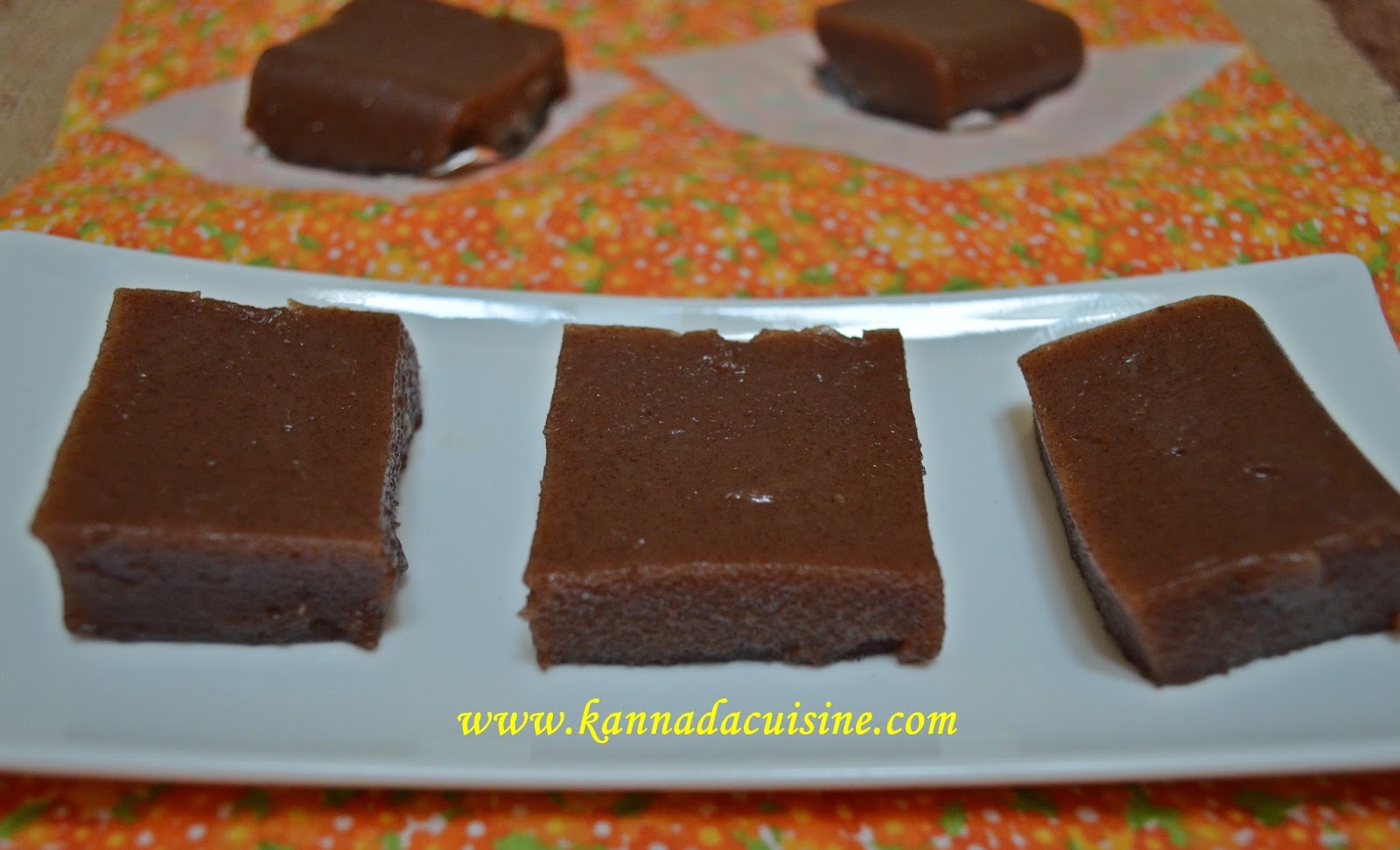
This year the offering on Vijayadashami was Halbai, a very traditional, tender burfi which used to break the back to prepare. Traditionally, ragi is soaked in water and ground repeatedly to extract milk. The milk thus extracted is combined with Coconut milk and Jaggery and cooked till the mixture coagulate into this jelly - burfi like goodness! But that is a really long process. Now that she is rather busy my sister has figured out an easy method as well. Just use finely sifted ragi flour and soak it in water for a few hours in lieu of the back breaking process of ragi-milk extraction. So here it is. If a lighter colored Halbai is preferred then stick to the traditional recipe!


We will need,


Ragi flour 1 measure
Jaggery 1 measure
Coconut milk powder 1/2 measure
Ghee 2-4 tbsp
Cardmon seeds (ground) to taste
salt a pinch.

Method:
  1.  Sieve the ragi flour using the smallest of mesh strainers. Discard the husky part.  Pour about half a measure of water into the sieved flour and set it aside.
  2. Crush the Jaggery, place it in a narrow bowl and cover it with water, should not be using more half to 3/4 measures of water.
  3. Stir in about 1/4 cup of hot water into the coconut milk power one tablespoon at a time making sure there are no lumps. Once all the hot water is used up, run the mixture through a sieve and make sure there are no lumps left behind.
  4. Once the Jaggery has dissolved, combine the salt, coconut milk, ragi flour mixture and the Jaggery mixture in a think bottomed pan. Place it on medium-low heat. Stir often.
  5. Spread about 1 tsp of ghee on a brownie tin or a plate and set it aside.
  6. The mixture will thicken gradually and starts to resemble molten fudge. It can splatter and will be super hot. Caution is required here.
  7. Pour in the remaining ghee into the hot mixture. Keep cooking till the mixture comes together into a ball and starts to leave sides.  Quickly stir in the ground cardamon seeds. Remove from heat and pour the mixture into the greased brownie tin/ plate. Cover and place it in the refrigerator for a few hours for the mixture to set. 
  8. Cut it into squares or desired shapes.

Chocolate Cashew Burfee for Navratri

It is my favorite time of the year! The season of festivals, joy of celebrating the victory of good over the evil and of course great food. Here is wishing you all a very happy Dasara. Dasara celebrations underway in Mysore and in the hearts of people from Mysore all around the world. We have a brand new Maharaja as well, though we do miss Srikantadatta Woodeyar and of course our dear Drona.


Bombe Habba is an integral part of Dasara. Here is our edition this year. As a part of the regular pooja for the Bombe -dolls we have to prepare offerings and good many a sweets have already made an appearance in my kitchen.  Here is the recipe for a relatively easy Burfee. After umpteen attempts to make good burfee at home, I finally think I have a recipe that has some potential. This recipe is still work in progress and needs to be fine tuned.I am making efforts to improve the texture of the Burfee and also make it more fail proof. But I was able to prepare three variations using the base recipe.  Posting the first of the three, the Chocolate Cashew Burfee

 We will need,

Sugar 150 grams
Water 100 ml
Ghee 75 grams
Milk powder about 200 grms
Cocoa 25-40 grams
Cashews (roasted and salted) chopped 2 tbsl
Lemon juice 1 tsp
Salt a pinch

Method:
  • Stir together cocoa ,milk powder.cashews and salt, set it aside. Grease a Thali or a tray with a touch of ghee and set it aside.
  • Combine water and sugar and bring it to a boil. Cook till it attains one thread consistency i.e when the sugar syrup is pulled between thumb and forefinger, it should stretch into a single thread.  
  • Pour in the ghee and reduce heat to medium low. Cook for a few minutes till it starts to boil again.
  • Stir in the lemon juice and the milk powder mixture. Stir till combined. Keep stirring till the mixture comes together. Once it comes together, turn off the heat and pour the mixture into the greased tray.
  • Spread the mixture around carefully using a spatula patting it down evenly across the thali. Use a roller pin if needed to flatten it out to required thickness. I like mine about 1/4" thick. Cool completely and cut as desired using a pizza cutter or a sharp knife.
Happy Navaratri and happy eating.


Pav Bhaji (without Potatoes)

Hmmm... What is Pav Bhaji doing on Kannadacuisine? I was actually thinking if I should post this recipe at all. Well there is nothing Kannada about Pav-Bhaji, but then there is nothing Kannada about Rasmalai or Dum Aloo either. But Rasmalai and Dum Aloo was cooked by me, a thorough bred Kannadiga. Well, if Rasmalai can make an appearance on Kannadacuisine, Pav Bhaji can very well. So there we go.

Pav Bhaji presented a peculiar problem in my Kannadiga kitchen. For starters, potato is a huge star here and we Kannadigas particularly the older generation have always been suspicious of potatoes. My grand mother never ate them and hardly cooked them because they were 'Vata' inducing and therefore bad for her arthritic knees. But for the occasional  Masale Dose or Aloogadde Bele Huli, potatoes were pretty much banned in her house and mine as well :)
For some reason, the worm in my mind tells me that my gut is not meant to digest potatoes. The fact that Sabarmati Hostel mess in JNU goaded a truck load of potatoes down my throat in the four years I was a resident does not do any good to my already shaky relationship with potatoes. So I had to eliminate potatoes from this recipe.

The second peculiar problem was the Pav itself. Bread back home is associated with fever! Though my more progressive English-minded father preferred to have his bread with eggs and butter, bread largely meant that some one was under the weather. So I had to make it a little more interesting on that ground as well.

The third peculiar problem was to balance the 'bread' factor with loads of vegetables in the Bhaji.
After putting all these problems in the pot and stirring my magic wand, I had ..... bingo Pav Bhaji on my tables. So here it goes.


 We will need,

Cauliflower florets 2 cups
Carrot 1 big chopped
Green Beans a generous handful chopped
(Optional, Zucchini, Peas, Bell Peppers :Vegetables in all about 4 cups chopped)

For the Masala:
Ghee 1 tbsp
Mustard seeds 1/4 tsp
Hing a generous dash +a generous dash

Onion 1 medium minced
Chilly Powder 1/2 tsp (adjust according to taste)
Dhania powder 1.5 tsp
Turmeric 1/4 tsp
Jeera Powder 1 tsp
Garlic powder a generous pinch
Amchoor Powder 1 tsp
Tomatoes 3 medium chopped
Salt to taste
Sugar a 1 tsp

To Serve :
Fresh butter
Bread of choice (I used Italian onion bread just to make it a little more interesting)
Lemon wedges and chopped onion

Method:
  • Wash all the vegetables in running water and drain well. Place them in a pressure cooker along with a dash of Hing and 3/4 cup water. Cook till the vegetables are tender. (One whistle on my Pressure Cooker) Set it aside.
  • Heat the ghee in a Kadai. Throw in the mustard and Hing. Once they stop spluttering, throw in minced onion. Saute till golden brown.
  •  Throw in all the spice powders and saute for a brief 15 seconds. Throw in the tomatoes. Stir well and cover. Reduce the heat to medium low and cook till the masala is fragrant. 
  • Meantime, when the pressure cooker is cool enough to open, remove the cooked vegetables into a wide mouth bowl and mash it with a wooden spoon /Masher.
  • Pour the vegetable cooking stock into the masala and stir in the mashed vegetables into the masala as well. Adjust salt and sugar. Simmer and mash till the dish comes together. Finish with a big dollop of butter though entirely optional.
  • Serve with lemon wedges, chopped onion and bread of choice


Oats Huggi

It has been a long break from the blogsphere. I could not muster the motivation to click pictures after cooking and writing. I was wondering if I had hit the wall and run out of words! That looked like a dangerous possibility. Obviously that was not the normal 'me'. Then after some pushing and prodding myself, I was able to get back to clicking pictures. I still have a list of recipes in my draft and hopefully I will let them see the light of day very soon.

I am not a very big fan of oats. But for occasional quick breakfast I would like to eat some with chopped apples, ground cinnamon, just a tad bit of salt and sugar. That works well with the quick cooking types. A few weeks back I was shopping at Trader's Joe and fell victim to product differentiation. I could not really make up my mind if the ones we typically buy is the Steel Cut variety or the Quick Cooking variety. For some reason some thing inside told me to pick up the Steel Cut ones and made this recipe happen.  Turns out that Steel Cut are the ones that resemble our 'Nucchu' where a whole grain is broken into a few pieces. Obviously they are not the ones that will work in the microwave oven for a quick breakfast. Now I am saddled with a whole box of oats, the variety we don't even use! I put on my thinking cap and zeroed in on Huggi. For one I knew oats being mushy and sort of sticky will work only in mushy rice dishes like Huggi and Bisibelebath. So here is the first attempt with Huggi and Honey loved it. I made this yesterday and he wanted me to make it today as well. Hell no. May be sometime next week.

   We will need,

Steel cut Oats 1/3 cup
Moong Dal washed and split (Hesaru Bele) 2 tbsp
Ghee 1 tbsp
Mustard 1/4 tsp
Jeera 1/4 tsp crushed
Hing a dash
Turmeric a pinch
Pepper corns 1/2 tsp crushed coarsly
Curry leaves a handful
Green Chillies 2-5 (adjust according to taste)
Coconut grated 2 tbsp
Salt and lemon juice to taste

Method:
  • Wash the oats and Moong dal in multiple changes of water. Soak it together for about 2 hours. 
  • Pressure cook with about 1.25 cups of water till the oats is soft and mushy. (Took two whistles in my pressure cooker). Remove from heat and set it aside. Wait for the pressure to reduce to proceed to the next step;
  • Prepare the Oggarane. Heat the ghee, throw in the mustard, jeera, hing and turmeric. Once the spices sizzle throw in the curry leaves, green chillies and coconut. Saute for a few second and remove from heat.
  • Now carefully open the pressure cooker and pour the Ghee and spice mixture into it. Stir well. Adjust salt and lemon juice. Warm thoroughly and serve immediately.

Tender Green Vegetables in Green Masala

Where have I been all these days ? It was summer followed by a vacation in India and then back to work while Sunny boy was not yet back to school. Now that the school has started, there is some degree of sanity.

Northeastern summers are absolutely beautiful. It is the time when there is life all around. The birds tweet and chirp, the leaves swish around in the breeze and the most precious of them all- the joy of noisy children playing in the neighborhood. These are magical days. Just throw a seed and lo behold there will be a creeper or climber all set to go on a squash/tomato over drive. I grew some green beans this time and some herbs on my small deck where there is hardly any sunlight because of the huge oak and maples beyond. But then, my kitchen is overflowing with home grown produce thanks to friends and neighbors. So much so that I am not accepting any more Zucchinis and Tomatoes!

Yesterday a dear friend gave me a bunch of tender green vegetables , a handful of green beans, a handful of cluster beans (Chapparavarekayi) and a handful of Daikon radish pods (Moolangi beeja) along with some okra. I was at my wits end when i peeked at the treasure. Though they looked awesome, the vegetables were not enough to make a stand alone dish with any one of them. So they had to go together and that is how this dish was born.


We will need,

Tender green vegetables ( Green Beans, Radish pods, Okra, Cluster beans etc)  trimmed 2 cups
Avarekaalu/ Lilva beans    shelled 1 cup
Garlic cloves 4 cloves
Ginger 1/2 "
Green chillies 7-10 (adjust according to taste)
Fresh Coriander a handful
Fresh Mint a handful
Turmeric 1/4 tsp
Peanut oil 3 tbsp
Cumin  seeds
Salt, sugar and lemon juice to taste

Method:
  • Trim the beans and radish pods, clean and wash them well. Wash the Avarekaalu.
  • Combine the garlic, ginger, green chillies, coriander, mint and turmeric in a blender and grind it with as little water as possible till the spices are smooth. Set it aside.
  • Heat 1 tbsp oil in a wok and stir fry the Okra. Once they brown on the edges and are not slimy remove.
  • Heat the remaining oil in a Kadai and throw in the Cumin. Once they stop spluttering, throw in the vegetables and Avarekaalu. Saute for a few minutes 
  • Pour in the masala paste and toss the vegetables in the masala. Add salt, sugar and lemon juice according to taste. Add a little water and cover. Cook till the vegetables are crisp tender. Keeping checking every few minutes to see that there is sufficient water in the wok.
  • Once the vegetables are done, remove from heat and serve with Rotis and Yogurt.


Chunky Style Mossoppu

Of all my memories, those related to food are still the strongest. Once a foodie, always a foodie I guess.  When we lived in Shankarmutt, Mysore a few decades ago, it was a different world. We could hear our father's bike from more than a kilometer, way before we could see him. We could climb on to our terrace on Sunday to see if the palace had been lit up. We used to wait for that occasional candy, chocolate that came our way, so much so that we did keep its wrapper for a long time between the pages of our books. I had a particular fascination for HaalKova, a little snack that they sold by piece in small Kirana stores. My father never allowed me to buy it because he felt anything in open or which was not branded was unhygienic. So one day when my mother asked me to fetch a package of salt the Kirana store, I got one Haalkova for myself with the change. I savored every bit of it on my walk back home. Later at home obviously I could not substantiate the change I had with me and the package of salt. Amma promptly walked back to the store to check on the change. Oblivious to what was happening I was went about my day forgetting all about the change and the HaalKova. When Amma returned I understood hell hath no fury like a mother tricked!
That was it. My longing for Haalkova remained. I would look at the white one and the brown one wrapped in pieces of parchment paper tied with a piece of sting and drool at them hoping for a day when I did have my own money I would eat up a bunch of them. Money came, Money gone, but that craving still remaines a craving.

That reminds of the old couple who had cultivated a patch of greens in an adjoining plot. They had a small well at the very end of the plot and Spinach, dill, Fenugreek, Dantu, Chikke,Chakkota and a many other greens looked cheerful in neat parallel rows. When ever Amma wanted to make Mossoppu, she did ask me to run over to the old couple with a coin or two in hand and return with the two or three bundles that went into lunch that day. It was as fresh as it could get. That was the only Mossoppu I knew for a long time and realized what was lost only after our tryst with the one made of greens that were grown near sewage outlets as was common in the Bangalore at one point in time.  Here is a toast to that time, a Mossuppu made leisurely when the mood is to relive the years gone by.

 We will need,

Toor Dal 1/2 cup
Garlic  cloves chopped 2
Onion chopped 1
Tomato chopped 1

Green Chillies to taste
Mixed greens washed trimmed and chopped 4 cups tightly packed
Tamarind extract 3/4 to 1 tsp
Ghee 2 tbsp
Mustard seeds 1/4 tsp
Jeera 1/2 tsp
Hing a generous dash
Byadagi chillies 2-3 broken into smaller pieces
Salt to taste

Method:
  • Wash the Dal in several changes of water and pressure cook with 2 cups of water till the Dal falls apart. Set it aside.
  • Heat a tsp of Ghee in a Kadai and throw in the garlic. Once the garlic is golden in color, throw in the onion. Saute for a few minutes and throw in the tomatoes, green chillies and the chopped greens. Cook till the greens wilt down. Stir the mixture into the cooked dal
  • Put the Dal and greens mixture on low heat. Add a little water if the mixture is too thick. Throw in the tamarind extract and bring the mixture to a gentle boil.
  • For the Oggarane, heat the ghee, throw in the mustard seeds, Jeera and Hing. Once the spices splutter, throw in the Bydagi chillies and curry leaves and remove from fire. Pour the mixture in the simmering dal mixture.
  • Adjust salt, crush the green chillies with the back of a spatula and remove from heat. Serve hot with rice or Ragi Mudde.


Badami Haalu 2 / Almond Drink

We were a generation that grew up watching advertisements for Nutramul, Horlicks, Complan the drinks that were supposed to make kids grow big and strong. Well my mother had her own recipe to make us big and strong. I love that version and make it very often. But for the weekday rush, I have slightly modified the recipe and make the almond mixture ahead of time so that my morning-pick-me-up drink is quick and easy. All it needs is hot milk and I am ready to go.
 
We will need,

Almond flour 1/2 cup
Sugar 1/4 cup  (adjust according to taste)
Cardamon 2 pods
Saffron a generous pinch
Salt a tiny pinch

And Milk
Method:
  • Combine the almond flour, salt and sugar in the mason jar. (I make my own almond flour. My grinder ends up with a slightly coarse flour, that is fine with me. Also the almond skin does not bother me) Check out some here.
  • Crush the cardamon seeds into a fine powder
  • Coarsely crush the saffron . Throw in the crushed cardamon and saffron into the almond flour mixture.
  • Close the jar and shake well. Also stir the mixture with a spoon to make sure it is well combined
  • Store it in a cool dry place. It stays good for about two weeks.
  • To Prepare the Badami Haalu, scald a cup of milk. Place 1 tbsp almond mixture in a  coffee mug. Add a few tablespoons of hot milk and stir to make a paste. Gradually add the remaining milk stirring the mixture carefully. Stand it for a few seconds so that the saffron does it's magic and lo! behold delicious Almond drink is ready.

Bottle Gourd and Panner Kofta Curry

There are time when I crave for rich luxurious foods, like Pooris, Makhani gravies etc. Kannadiga being simple to the core were not all the great at conjuring a dish which could qualify for 'heart attack on a plate'.  The typical Malai Kofta is rich and luxurious. Since I was cooking for my Amma and she is a very picky eater and her no list includes Panner, Mushroom, corn -anything that we as kids did not see on the super market i.e Janata Bazar shelves three decades ago. So Malai Kofta was out of the question. So I married Malai Kofta with Lauki ke Kofte and bingo, there was a dish that satisfied my craving at the same time my Amma could enjoy it too.

So comes the Kofta curry.
We will need,

For the Koftas:
Bottle gourd 1 cup (grated and well squeezed)
Panner 1/3 cup crumbled
Rice flour 2-4 tbsp as needed to get the mixture together
Green Chillies minced 3-4 (adjust according to taste)
Mint a handful chopped
Ginger 1/4" grated
Salt to taste
Sunflower oil to deep fry

For the Curry:

Tomatoes 3 medium
Ginger 1/2" piece
Green Chillies 2-3 Adjust according to taste
Mint leaves a handful
Coriander leaves a handful
Cashews 5-6
Ghee 3-4 tables
Black Cardamon 1
Green Cardamon 2
Star Anise 1
Jeera 1/4 tsp
Red chilli powder 1/4 tsp
Dhania powder 1 tsp
Turmeric powder 1/4 tsp
Garam Masala a generous pinch
Milk or water about 1/2 to 1 cup depending on the thickness of the curry desired.

Method:
  • For the Curry, combine the tomatoes, ginger, chillies, mint  and coriander leaves in a blender and pulse it till the mixture is smooth. Set it aside. Separately grind the cashews along with a little water into a fine paste. Set it aside.
  • Heat the ghee in a Kadai. Throw in the whole spices. Once the spices stop sizzling throw turmeric powder, dhania powder and chilli powder. Saute for a few brief seconds pour in the tomatoes mixture. Make sure to not burn the spices.
  • Cook till the the fat separates. Now throw in the the cashew paste and a 1/2 cup of water and simmer.
  • Now for the Koftas.Place the oil in a Kadai and heat it on medium.
  • Mix all the ingredients except the oil. The mixture should come together like a dough. I do not typically add extra water because there will be enough in the gourd and Panner. Adjust seasonings. 
  • Pinch small balls of the mixture and roll it into Koftas. Deep fry till golden brown. Drain on paper towels and reserve.
  • Once the curry has simmered and has the desired consistency, sprinkle the Garam Masala, adjust salt and cook for a few more minutes. Just before serving, throw in the Koftas and serve immediately.