Showing posts with label Festival. Show all posts

Ugadi Playbook - How to put together a traditional Ugadi feast without the fuss

Wishing all my readers a very happy and prosperous Kannada new year. I rarely ever end up wishing my readers on festivals. Ugadi for instance, I had grand plans of wishing my readers but turns out that I was busy cooking, eating and merry making with friends. It is good in a way that my actual life takes precedence over virtual life. But then I did really love to do a post right on time someday.

Putting together Ugadi feast is like putting together the Thanksgiving feast. The difference is probably in the calorific value of the meals though. An average Thanksgiving meal is supposed to contain about 3,000 to 4,500 calories but Ugadi meal will probably be around half the calories with a potential to trim more without anyone noticing. Looking at the number of items cooked on a day like Ugadi, putting together the feast might look very intimidating, especially for newbies. So I thought of putting together a plan - a play book to help busy folks plan and put together a traditional Ugadi meal. It is also a good time to have little hands help out here. So enlist your children and assign simple tasks.

Traditionally, Ugadi meals consists of Holige , holige Saaru , cucumber kosambari , hesaru kosambari , green beans palya , mango chitranna , a variety of payasa, papads, bhajjis/pakodas , pickles along with white rice and fresh yogurt. Dishes are added or removed depending on preferences. But this essentially is the template. I start on the weekend before Ugadi, prepare my shopping list and make sure I have all ingredients. So here comes the shopping list.


Weekend before Ugadi, shop for all necessary ingredients. If there is no time constraints or if it is possible to shops two days before Ugadi, that should also do. We will need the following ingredients to cook a meal for vegetable loving 2 adults 2 kids.

Neem flowers (for bevu bella)
roasted chickpeas (kadale pappu for bevu bella)
Kopra (also for bevu bella)
Mango leaves (for torana)

Carrots 1 large
Green beans 1lb
Cucumber 2-3 medium
Coconut 1 whole
Green Chillies 1/4 lb
Curry leaves
Coriander
Tomatoes 2
Milk (optional, if making milk based payasa)

Rice 2 cups
Toor dal 2 cups (makes 15 medium size holige)
Jaggery 1 lb
Maida about 2 cups
Sugar (if called for in the payasa recipe , else Jaggery should do)
Peanut oil
Mustard seeds
Jeera
Hing
Dry red chillies
Salt
Peanuts
Ghee
Vermicelli/ sabodana/sooji/ channa dal/ moong dal as needed for Payasa
Choice of papad

Other optional ingredients:
Pulioggare mix for pulioggare
Mango pulp, fresh ripe mangoes for Seekarane
Chickpea flour for Bhajji or split chickpeas for vada

Once the ingredients are handy prepping will be a breeze.

One day before Ugadi:

  • Prepare the hoorana filling for the Holige.  Clean the kitchen after the sticky mess of hoorana filling.
  • String the beans, wash, chop it for Palya and store it in the refrigerator.
  • Prepare the chitranna gojju and store it in the fridge
  • Grate carrots for kosambari and store it in the fridge.
  • Grate coconut if using a whole coconut. If using frozen coconut, thaw the package in the refrigerator overnight.


On the morning of Ugadi, typically we do not have breakfast, we just go ahead with a brunch. It took me two hours to put together the meal below. I had the hoorana filling prepared the previous evening. Sunny boy helped me chop the cucumber and green beans. Other kid friendly tasks include mixing the Chitranna /pulioggare, chopping coriander. I find it sad when kids raised here in the States do not like to eat Indian food. I hope that enlisting their help would make them feel the spirit of the festival also encourage them to try and eat Indian food.
  • First get the rice going. We need the rice to cool down to be able to mix chitranna/ pulioggare
  • Make the kanaka dough for holige and set it aside.It needs time to rest.
  • Make the payasa.
  • Meantime, kids work on chopping cucumbers etc.
  • Start the beans palya.
  • Next work on the Holige saaru
  • Prepare the oggarane for the kosambaris all in one batch. 
  • Assemble the kosambaris and divide the oggarane between the two types of kosambaris. 
  • Mix the pulioggare if making
  • By this time most of the dishes are done. So start on making the holige. 
  • Once the holiges are ready prepare papads/ vadas/bhajji
  • Just before the family is ready to eat, add salt and lemon juice to the kosambaris.  Mix the chitranna gojju with rice. 
Bingo the meal is ready.

Rasayana

Wishing you all a very Happy Mahashivratri. Shivratri is said to be the day on which Lord Shiva in order to save the world consumed the poison that emerged from Samudramanthana. Alarmed Parvati then choked Shiva hoping to stop the poison from entering his body. The poison then was held at his throat turning it blue giving them the name 'Neela Kantha' or 'Vishakantha'.  Essentially like most Hindu myths this one too is the victory of good over evil, victory of Amrutha over Halahala. So we are supposed to contemplate of the negativity in our lives and try to get rid of it today. Devote fast, meditate, keep vigil through the night. Keeping up through the night is a tall order for me, so is meditation. But fasting is fine. Thankfully there is no one way to celebrate festivals in the Hindu pantheon. It is just a balance between celebrating life and mindful living that is at the core of these celebrations. So this one is fasting before Ugadi brings feasting with it.

As I explained to Sunny boy the significance of Mahashivratri, he got all excited and wanted to fast the whole day. I had to convince him that fasting was for adults and that kids need to eat well. The promise of allowing him to fast once he reaches high school brought me momentary truce. The next complaint was that his school did not declare holiday for Hindu festivals except Diwali. He held the temple calendar in his hands and started examining the number of Hindu holidays. With so many of them, he wishfully said 'had school closed on all Hindu festivals we did pretty much have no school. That would have been fun'. Excited at his discovery, he left for school have a great deal to share with his friends for the day.

Today, since it is the day on contemplation, I sit here wondering how time flew. This blog is a decade old, Sunny boy just a tad younger than that. I am that much older. Many family members who found their way into my stories on this blog are long gone. Most cricketers in the Indian ODI team are younger than me. Grand slam winners are decades younger than me. The software that inspired awe in a younger me are no longer around. Shops where we frequented are no longer around. It is just time, it waits for none. Then I look at folks in my family who are in their eighties. Every time I meet them, I thank my stars for this chance. They might be gone the next time around. Or the other way around. I wonder if it is mid life that makes you acutely aware of your own mortality.
Then I wonder how it must be of the older folks in the family. Most of their peers are gone. Life as they knew has changed beyond their wildest dreams. But they all know their family makes them the happiest.
Here is to family, fasting and feasting. Rasayana is a version of fruit salad. During my visit to Puri earlier this year, we got to taste a Rasayana like dish.It had sweet but savory overtones as well and it was delicious.I have tried to recreate it here.


We will need,

Ripe but firm Bananas 3
Pomegranate seeds 1 cup
Coconut shredded 1/4 cup
Cilantro /fresh coriander chopped 1 tbsp
Lemon juice to taste
Black Pepper ground to taste
Chat Masala (optional to taste)

Method:
  • Place the Pomegranate seeds in a mixing bowl. Peel the bananas and diced them. Toss the diced bananas into the bowl with the Pomegranate seeds
  • Toss the rest of the ingredients together. Serve immediately. 
Note: Many people do not consumer salt while fasting. Chat masala can be skipped if that case. Also Sendha Namak  can be used in lieu of salt if that is acceptable. 


Brown Burfi

Happy Navratri and Saraswati Pooja. It is my favorite time of the year. While it is a time for many to fast, it is time to feast here. Now is the time I end up making loads of goodies and apologetically devour them all. After all Bombes in Bombe habba need to eat enough to last their upcoming year long hibernation in the dark store room. Here is our Bombe habba 2017 edition. Ideas are hard to come by for a traditionalist like me doing it every year. But then something needs to be different each year otherwise it would become a chore. This year, the runners are new, hopefully one year is good enough time to figure out the scheme for 2018.


Now for the unapologetic feasting part. It is already the Saptami or the Saraswati Pooja today. Lot of entertaining and Bombe /Golu hopping is already behind. Three more days left to feast and then comes the deluge of guilt. Before that happens, I will loll around dressing up in silk saris, jewelry and eating great food. I am so contended in my hedonistic cocoon right now that I do not even miss onions, garlic and eggs.
Sweet of the day today is brown Burfi. So here it comes.


We will need

Evaporated milk 1 measure
Ricotta Cheese 1/2 measure
Light brown sugar 1/2 measure
Butter 1/4 measure
Cardamon powder a generous pinch

Method:
  • Place a piece of parchment paper on a tray or a baking dish. Set it aside.  Keep a bowl of ice water handy.
  • Combine all the ingredients in a wide mouthed non stick pan. Set it on medium flame. Keep stirring continuously. 
  •  Once the mixture starts to bubble all around and starts to resemble lava, reduce heat. Scoop up a teaspoon of the mixture and carefully pour it into the bowl of ice cold water. Try forming a ball using the mixture in the water. If it forms a soft ball the mixture is ready for the next step else keep stirring it on low heat checking for the soft ball stage every couple of minutes or so.
  • If it is ready ,remove from heat and let it cool for about 15-20 minutes. or until the mixture starts to thicken.  
  • Give it a good stir till  the mixture looses its sheen. Pour it onto the parchment lined tray. Spread the mixture around uniformly and set it aside to cool and set completely. 
  • After the mixture has set, cut it into desired shape and store it in an airtight box.

Ricotta and Panner Peda


After several years I have started watching a Hindi soap rifling off the internet. I would have loved to watch it legit but for three reason. I am a streamer and I don’t even own a TV, though technically Honey has one in the basement it is far too complicated. That damn thing comes with four remote controls. Turning it on is a nightmare, let alone surf for the right input and subsequently the channel. I did rather solve some trigonometry sums than try to venture into the realm of TV. Miss you KEONICS on/off TV. Two, Hotstar does not stream in USA. I wrote them several times but they would not listen. They don’t even have it on amazon prime channels or Netflix. I almost fell of the chair thinking of Desi soaps on Netflix/Amazon prime. They can fit in tens and thousands of content in the space needed to fit in just Kyun Ki Saas Bhi Kabhi Bahu Thi. Imagine Game of Thrones versus Kum Kum Bhagya, economics of cloud bytes!!

Post justification for rifling, let us get to the soap. Boy! It is hard to wait. I mean being a streamer and oldest of millennials I loose out on waiting game even before it starts. Hello! how can you go on for days without watching how it ends. Not that I did not watch soaps before. I do remember watching several of them on Doordarshan including Shanti and Swabhiman but those were the times we had only them to watch and nothing else. If there was a power cut during the air time we lost those episodes forever. Also I remember watching a weepy called  Thoda Hai Thode Ki Zaroorath Hai. This one was probably a weekly. Not sure though, it is been a long time and as can be expected I abandoned it midway after it got too tedious. I did watch the Kyon Ki Saas Bhi Kabhi Bahu Thi initially when Tulasi was a Physics MSc topper (anyone remember?) and abandoned it once she because bahu wearing ridiculous jewelry/sari. I should mention a disclaimer here. I did watch Iss Pyar Ka Kya Naam Doon the original one. It so happened that when the male lead quit the show there was a great hubbub, it was in the newspapers, internet everywhere. I was the proverbial cat that got curious and rifled though the internet and saw one of the episode. The male lead was super attractive, female lead good, story intriguing and it got me hooked. The soap was by then off air and here I was trying to catch up from episode 1. I did manage to watch the whole thing in about a week, of course forward tab helped. Since I started with last episode, there was no waiting to know the end and it suited me perfectly.

Now for the current soap, how is that the hero and heroine always manage to tangle their dupatta/watch, bracelet /watch. God knows, it is like they wear their accessories with single intention of getting tangled with the other person. It has never once happened to me in real life and I am a rather clumsy person, yeah I have stumbled awkwardly in platform heals, tumbled down wearing PJs but never got tangled in another person’s accessories, not even in my sisters long hair back when we used to share the same bed, not even when sleeping like a logs. I always wonder how the writers came up with this kind of situations. And then hero and heroine manage to get locked in store rooms/ horse stables/lifts/jungle lodges, their own homes and what not. And the viewers are supposed to interpret it as a romantic getaway! Wonder if the writers have any clue how it might pan out in real life? If I ever get locked in a store room or lift with Honey, it would scare the living daylights out of me. What are we to eat? what about coffee? Honey would turn into a vampire without periodic ingestion of caffeine.(Periodic I mean once every 60-75 minutes) Even if single but people with mutual interest were locked in I seriously doubt if they think of a song and a dance instead of figuring out a rational way to get out. So much for willful suspension of disbelief, but hell I am hooked now and I cannot stop watching. Time to check into soap rehab -now called 'netflix'.
  
How the hell did I end up writing about soaps when I should have been writing about Peda? There is a connection. Yesterday was Sri Krishna Janmashtami and I made some Pedas. Every time I think of Krishna, I do think of Nitish Bharadwaj –remember the guy who played Krishna in the original BR Chopra Mahabaharata? There is goes, even gods are not free from the clutches of soaps, I am a mere mortal. After all this I did not even realize my pedas were out of focus. But it is too late, Pedas are gone. I will go ahead anyway.

This is what I do every festival season, get vats of ricotta cheese and sneak it in as many dishes in every possible combinations.
Here we go, we will need,

Fresh Paneer 1 measure
Ricotta cheese 1 measure
Jaggery 1/2 to 3/4 measure
Cardamon 1 pod (seeds crushed. save the skin to make masala chai)
Ghee a few tsps

Method.
  • Crumble the Paneer into a thick non stick pan. Scoop the ricotta into it and mix. Place the mixture on low heat. 
  • Crush the jaggery and stir it into the cheese mixture. Keep stirring gently so that the mixture does not burn. The mixture will loosen up but keep stirring till it leaves the edges and comes together into a ball. Remove from heat.
  • Stir in the crushed cardamon. Using the back of a ladle, rub the mixture against the bottom of the pan. 
  • Once the mixture is cool enough to handle (but very warm), remove it onto a greased platter and rub it well using the heal of your hand till the mixture is soft and no longer crumby. Pour in some melted ghee if the mixture is sticky or feels too dry. 
  • Make it into a log and pinch balls the size of a gooseberry and press it into desired shapes. Refrigerate or consume immediately.


Chocolate Cashew Burfee for Navratri

It is my favorite time of the year! The season of festivals, joy of celebrating the victory of good over the evil and of course great food. Here is wishing you all a very happy Dasara. Dasara celebrations underway in Mysore and in the hearts of people from Mysore all around the world. We have a brand new Maharaja as well, though we do miss Srikantadatta Woodeyar and of course our dear Drona.


Bombe Habba is an integral part of Dasara. Here is our edition this year. As a part of the regular pooja for the Bombe -dolls we have to prepare offerings and good many a sweets have already made an appearance in my kitchen.  Here is the recipe for a relatively easy Burfee. After umpteen attempts to make good burfee at home, I finally think I have a recipe that has some potential. This recipe is still work in progress and needs to be fine tuned.I am making efforts to improve the texture of the Burfee and also make it more fail proof. But I was able to prepare three variations using the base recipe.  Posting the first of the three, the Chocolate Cashew Burfee

 We will need,

Sugar 150 grams
Water 100 ml
Ghee 75 grams
Milk powder about 200 grms
Cocoa 25-40 grams
Cashews (roasted and salted) chopped 2 tbsl
Lemon juice 1 tsp
Salt a pinch

Method:
  • Stir together cocoa ,milk powder.cashews and salt, set it aside. Grease a Thali or a tray with a touch of ghee and set it aside.
  • Combine water and sugar and bring it to a boil. Cook till it attains one thread consistency i.e when the sugar syrup is pulled between thumb and forefinger, it should stretch into a single thread.  
  • Pour in the ghee and reduce heat to medium low. Cook for a few minutes till it starts to boil again.
  • Stir in the lemon juice and the milk powder mixture. Stir till combined. Keep stirring till the mixture comes together. Once it comes together, turn off the heat and pour the mixture into the greased tray.
  • Spread the mixture around carefully using a spatula patting it down evenly across the thali. Use a roller pin if needed to flatten it out to required thickness. I like mine about 1/4" thick. Cool completely and cut as desired using a pizza cutter or a sharp knife.
Happy Navaratri and happy eating.


Kadalebele Payasa with condensed milk


Of late food scene in India has exploded. We see so many restaurants, cuisines of all kinds in tier two cities as well. Super market shelves are exploding with new ingredients, sometimes for better and some times for worse. In these times, how do we cope up with such drastic infusion of new knowledge? For instance Australia is dumping oats in the Indian market. Internet and pop scientists are singing the praise of Oats so much so that it is now very difficult to separate the fact from noise. Bloggers have caught up too. Makes Oats Idli, Oats Poha and what not. I see my family members, educated and professional falling prey to the 'Miracle Oats' machine. They say they are eating healthy and that they are eating Oats for dinner. Really?

Oats like any other grain is a rich source of carbohydrate. Well it might be marginally better than rice, or just as good as Ragi, it still remains a grain and carbohydrate. The problem with our generation is that we are eating like our ancestors did plate full of starch while living a sedentary life. So we are consuming more calories than we can actually burn.  But the solution is not just reducing the number of calories consumed, in which case we will have to eliminate fat which happens to be the most calorie dense food group. Not all calorie is created equal. We need to keep in mind that all nutrient groups are vital to our body including fats and protein. Remember high school biology? Vitamin A is fat soluble! Eliminating fat is not a convincing solution. Nor is eliminating Protein. But reducing starch makes more sense. But again, very low starch diet like the Atkins diet might not be for every one. Definitely not me. Being Indian, I am genetically predisposed to like and thrive on carbohydrates.  But given the modern conveniences and my desk- life, I try to cut back on carbohydrates and sweets while generally consuming fats(one of ghee, coconut oil, filtered peanut oil) and lots of vegetables and fruits. My protein includes legumes of different kinds, eggs, occasional fish or chicken. But if I am asked to eat oats Idli, oats Pongal or Oats Poha? No thank you very much. Oats is probably as calorie dense as rice while not giving me the comfort that rice gives me. I did rather eat half a cup of rice and feel contended than eat one bowl of oats. Eating oats does nothing to my soul or for that matter not much better for my body either.

The same philosophy when indulging in treats like sweets. I see fat-free sweets and snacks in the super market all the time. They mostly taste bad, either loaded with sugar or sugar substitute and assorted ingredient that I cannot even pronounce. There are many such crappy food sold as 'organic' as well. Just because they used Organic sugar does not make a product better. I would rather eat a few spoons of real sweets that would make my soul happy than eat bowls of stuff that does not make my soul happy while being just as bad. The saying in Kannada goes (Vrata kettaru sukha padabeku: meaning If at all your penance is disturbed, make sure to have fun).

So here is one such recipe, that to me is soul satisfying, so rich that just a few spoonfuls will make your stomach and soul happy. Kadalebele Payasa comes in two different varieties. One where the dal is cooked till it falls apart, the other where the dal is still al-dente and is cooked in coconut milk like this .

We will need,

Split chickpeas /Kadalebele/ Channa dal 1/2 cup
Sweetened condensed milk   about 1/2 a cup
Milk as required
Cardamon powder a pinch
Ghee 1 tbsp

Method:
  • Wash the dal in several changes of water and place it in a pressure cooker. Pour 1 +1/4 c of water along with a drop of ghee and cook till the dal is soft, my cooker does it in 2 whistles. Remove from heat
  • Once the pressure cooker is cool enough to handle, open the lid and stir in the condensed milk and ghee. Place it on low heat.
  • If the mixture is very dry, add milk by the tablespoon at a time to thin the Payasa to a desired consistency. 
  • Once the mixture starts gently bubbling again, stir in the cardamon powder. Remove from heat. 
  • Serve Warm, room temperature.

Quinoa and Strawberry Kheer

Fashion has not spared food. We come across some fad, some really 'cool' ingredient to work with often. Then comes a deluge of good things about the ingredient. Once people start consuming it in a big way, the bad news starts popping up here and there. But by then who ever had to make money on that particular ingredient would have made money and moved on to the next big thing. Can we insulate ourselves from the deluge of information, marketing tactics? Let us examine the case of coconut oil. Coconut oil was a widely consumed product on the west coast of India. We people from the coconut belt consumed one coconut/meal/family. Back then our people were strong, healthy and enjoyed a good life. However during my teen years, we were told the coconut is very high in cholesterol and we should avoid it. Obviously it was not  true, it is high in saturated fats which is a good thing! I used to fight with my mom when she used a lot of coconut in her Palyas/Huli etc. Mom would defend her action saying coconut was good for hair and complexion. But as a head strong teenager, I thought I 'knew' better than her. Poor Mom, that was the only way she knew to cook but she adapted to using lesser coconut over the years. We started eating refined sun flower oil which had no smell, which stayed good indefinitely and which looked thinner therefore 'felt' much healthier than either coconut oil or our own filtered groundnut oil.
Then I moved to the States and found canola oil was the oil in 'fashion' and started eating it, though I never liked the weird taste and flavor it had.

Now life has come a full circle. Coconut oil lobbies took a decade to realize that if they did not  fight back the battle of information with more information, people would stop eating coconut oil all together and their business would be shut down. So then came the wave to information and research on coconut oil. They some how proved that coconut oil was good for you and eating a teaspoon was heart healthy. The proof of a successful counter attack by the coconut oil lobby? Big cans of organic virgin cold pressed coconut oil on Costco shelves. That is good news for me though. I have gone over several cans of it and absolutely love it. But this was a story of 'good food'-'called bad'-'then back to being good'. But then there are so many bad foods in the disguise of good foods too. It has become so hard for a well informed person to judge what is good and what is not, let alone lay people like us.

I have been one of those people who gets carried away by such fads. Though these days I am a lot of cynical about such researches and do not experiment as much as I used to before. From my experimenting days I had a bag of Quinoa lying in my pantry for ages now.  I have been thinking of using it more often but then buying fad foods is one thing eating it is yet another. We actually did not like it much and I am happy with my Rice-Ragi-Wheat diet. But then I had to use up this bag of Quinoa. So here is something I did with it, Kheer!
I would not recommend people to buy bags of Quinoa to make this Kheer, but if you happened to have some in your pantry and struggling to get over with it, here is a recipe to try.


We will need,

Quinoa 1 cup
Sugar 1/2 cup
Evaporated milk 1 cup
Salt a pinch
Strawberries washed and chopped

Method:
  • Wash the Quinoa with a little water rubbing between your palm very well. I was told that it could get bitter if we did not wash it this way. Cannot comment much on it given my limited experience.
  • Once rubbing is done, wash it well with several changes of water.
  • Place the Quinoa in a pot and cover it with 1 and 3/4 cups of water. Cover and bring it to a boil. reduce heat and simmer till the Quinoa is soft. 
  • Throw in the evaporated milk and sugar and stir. Cook on low heat till the mixture comes together. Remove from heat.
  • Once the Kheer is cool enough to handle, fold in the the strawberries. Cover and stand the Kheer for a few hours for the Strawberry flavor to seep into the Kheer. Serve cold or at room temperature.

Short Cut Kajjaya

We love our Kajjaya. But it is really a labor of love. It takes for ever to get done. Soaking the rice, grinding it and then making the Kajjaya mixture and then deep frying, indeed it a time consuming and laborious process. This time I decided to see if I can some how make it a little easy for myself. I did experiment a bit and finally it looks like I did cut down on a couple of steps. If making Kajjayas in huge quantities traditional recipe is still the gold standard. But if you are making a smaller batch like me this time around, this will just be good enough.

Cooking is a science. Most of our traditional recipes have roots in Ayurveda. Our palates are accustomed to recipes which probably started off as a part of Ayurvedic life style. Making great Kajjaya is as rigorous as a science experiment. It is very unforgiving as well. A little less moisture the batter will simply disintegrate, a little more moisture the Kajjayas will turn up like beer battered rice flour!

The other day some one asked me why their Kajjayas disintegrated once the batter was dropped into the ghee. Well I did get the answer during my experiments. The deal is rice flour is naturally gluten free. So it is inherently difficult to get rice flour to bind. Typically we encounter this problem while preparing Akki Rotti also. To improve the cohesiveness of the Rotti what we do is cook the rotti dough briefly. Somehow, hot water and gently cooking it briefly makes our Rotti dough pliable, elastic and cohesive something like what gluten does to wheat flour.  So that was one challenge solved.


The other challenge was to make sure that the rice powder had enough moisture to 'cook' in the Jaggery syrup. So to solve this problem, here is what I did.


Rice flour (yes! the rice flour out of the bag)  1/2 cup
Jaggery grated just shy of 1/2 cup
Hot water 2-3 tbsp (or more depending on the rice flour)
Cardamon.
A combination of Ghee and sub flower oil for deep frying

Method:
  • Place the rice flour in the food processor. Pour the hot water over the rice flour and process it for a few seconds till the mixture resembles bread crumbs. The rice flour is ready when it comes together when pressed in our fist. If it does not, add spoon fulls of hot water and process till it achieves the desired status.
  • For the syrup, combine Jaggery with a tablespoon of hot water and cook till it reaches the softball stage. 
  • Dump the rice flour and stir vigorously. Toss in crushed cardamon seeds. The mixture will be fairly runny at this point.  Remove from heat but keep it covered. Once cool, the mixture will become slightly thick, sort of fudgy. It can easily be pinched into lemon sized balls and patted into small circles.
  • Heat ghee and sunflower oil in a  Kadai. 
  • Pinch lime sized dough and roll it into small balls between your palms. Place the rolled ball on a piece of wax paper and flatten it out into small circular discs. 
  • Once the ghee is hot enough, gently lower the flattened disc. Deep fry on medium heat till golden brown in colour.
  • Remove using a slotted spoon and drain on paper towels.  Serve warm or at room temperature.

Kalakand

We are proud of our diverse society, something that is in or DNA.  While it is cool to be a multicultural society, it takes a lot to be there and be nice especially with all the under currents of dissatisfaction that lurk around us.

Yesterday a few guys from the North East were beaten up by some local boys in Bangalore for not speaking Kannada. The English media was quick to condemn the attacks and indeed they are right in doing so. There is of course no role for violence of any kind in a civil society. We Kannadigas despite the highest number of Jnanapeetha and rich cultural heritage we never encouraged militant language fanatic groups. Violence is just not us. We take pride in our tolerance, sophistication, in our accepting and accommodating different groups. No wonder Bangalore is as cosmopolitan as it could get.   But the story does not end there. The last decade or so things have changed. The under currents of dis-satisfaction has become more and more apparent. Incidents like the ones mentioned below started to occur quite frequently.

One morning I was to ride a BMTC bus, I do not remember where I was going, but as I walked to the bus stop the bus started moving, I ran after the bus. The bus stopped suddenly, perhaps bus driver had noticed me. I boarded the bus and thanked the driver in Kannada and found myself sitting in the first row. After the next couple of stops the same scene repeated, a very well dressed girl ran towards the slow moving bus saying 'roko, roko' (stop in Hindi). The bus driver suddenly accelerated and the girl was not able to board the bus. I later heard the conductor and the drive have a conversation about how the girl spoke in Hindi. 'Bari Stylu' I heard him say as if, 'Oh! you think you are cool speaking Hindi? we do not think so. So wait for the next bus'.

Then once on one of my early sojourns into the northern plains on the great Karnataka Express, I found myself in the amusing company of a bunch of North Indians. I was the only women in the cubicle and the rest of the five were all north Indian men of various ages. After a polite introduction I found myself defending Kannadigas and south-Indians in general. They started ridiculing everything that we valued, right from making fun of Idli and Dose, how Kannada sounded like a can half filled with pebbles, how Kannada movie heros are dark skinned, old and ugly and how heroines were very fat etc. Being the younger me, I let my blood boil. It did not help that I was heading back to university at the end of my vacations. I defended everything they said wildly. I probably would not do it today because it was just a bunch of loosers bully a young girl whom they found alone in their cubicle. What really riled me was their attitude. I knew all of them worked in Bangalore. All of it stopped when I told them that I pity their situation. How horrible it must be back home for them that they should be coming to a problem filled Karnataka to make a livelihood.

These two were not isolated incidents, it eventually became a pattern coming across more and more often..Some how there was an air of elitism when it came to Hindi and everything North-Indian. How Delhi had huge fly overs and Bangalore had none.Why could not people after having lived in Karnataka for years show some respect towards the land? Learning Kannada would be the best tribute to the land. Agreed it is hard, but there are people who make an effort and their broken Kannada is appreciated.

The unwillingness to learn Kannada is viewed as a pseudo-elite rebuke to the locals and that is the reason why the guys were trashed the other day. It did not help that they look different too.

When I read about racism, intolerance and all that written about incidents like these, I squirm. Yes there is intolerance, but why did this intolerance begin in the first place. No one seems to ask that question and definitely not the English media. Disrespecting your host is never a good idea, is it ?

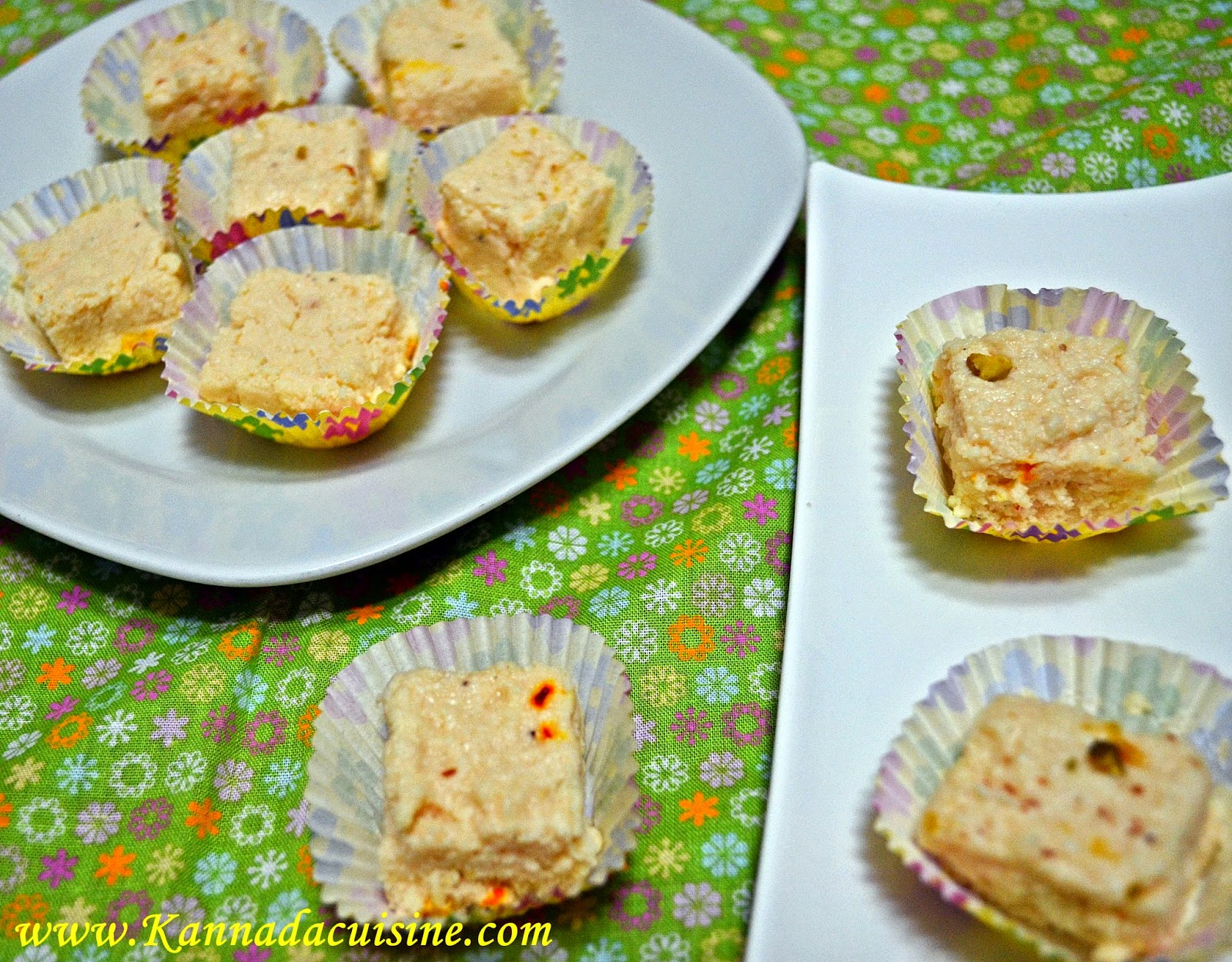
Now for the Kalakand. Like the good Mysore pak, this mildly sweet, moist and milky goodie is a rarity. Cheaper imitations are found in plenty, the ones the smell like stale Khoa, the ones that are dry and crumbly. But the ones that moist, with just the right amount of sweetness is so hard to come by.  I made these during Navratri and they were very well received.

We will need,

Ricotta cheese  15 oz can
Condensed milk 7 oz (half a tin)
Cardamon 2 (seeds grounds and  the skin discarded)
Kesar a pinch
Milk 1 tbsp
Pista for garnish
Ghee a tsp

Method:
  • Pop the ricotta into the freezer for several hours and thaw it for a few hours on the counter top. (I do this to separate the milk solids from the whey)  
  • Line a sieve with a cheese cloth and dump the ricotta into  the sieve. Discard the whey and save the milk solids.
  • Warm the milk , stir in the saffron and set it aside. Grease a tray with ghee and set it aside.
  • Once the ricotta is drained well, combine it with the condensed milk  in a microwave proof bowl. 
  • Pop it in the microwave for 3-4 minutes on high. Remove and stir well, add the cardamon, saffron mixture and microwave it on high again for 2 minutes. Repeat this every minute or so keeping a close watch on the mixture, till it gets bubbly and leaves the side of the container.  It took me a total of 8 minutes. But the duration can change depending on the quantity, the moisture in the ricotta and also the power of the microwave oven.
  • Dump the mixture into the greased tray. Even out the mixture and sprinkle grated Pista on top. Refrigerate for two hours, remove and cut it into pieces


Quick Carrot Halwa

Wishing you all a happy Ayudha Pooja. Also spending a minute here to remember Gandhiji and Sastriji on their birth anniversaries as well.

It is poignant that the Prime Minister should be kicking off the Swacchata Andolan today. Cleanliness is all about attitude, much less about resources. During my younger days, in one of the several towns we lived , I had noticed something. It was summer and there was no piped water back then in the town. We all had to collect water from street side taps and store it so it lasts for 3-4 days. About half a kilometer from where we lived was the area where the 'Vadda's a Dalit subgroup lived. We used to pass the 'Vaddara Hatti' as the area was called sometimes. They did not have street side taps, probably they got all the water from one of the wells in the area. Their houses were small compared to our own but their yard relatively big and very well maintained. The yards would be plastered using cow dung  which was a common practice back then to keep away the wild dusty earth a little more tame. Also part of the year were beautiful Rangolis which were drawn when the cow dung plastering was  moist so that the Rangolies lasted a little longer. Such yards were extensions of the tiny houses. Women sat in the yards doing various chores, kids played around, they also combed their hair, did a lot of routine activities in the yard.  The point is that particular area was much cleaner than our own area where the houses were bigger. It was about attitude and need than resources. How do change attitude is the question.

For now it is a quick Carrot halwa. I made this as an offering on one of these days. It was quick for a week day and much lighter than the regular fare. So here it is.

We will need,

Carrots grated 2 cups
Condensed milk 1/4 cup
Ghee 2-3 tbsp
Almonds  4-5 chopped
Raisins a handful

Method:
  • Heat ghee in a skillet. Throw in the almonds and the raisins. once they are golden brown remove them one to a plate using slotted spoon. 
  • Throw in the carrots and saute till the moisture is gone and the carrots are fragrant about 8-10 minutes.
  • Pour in the condensed milk stir and cook till the carrots are soft. 
  • Fold in the almonds and raisins. Serve at room warm or at room temperature or chilled.

Rice Badam Kheer

Dasara is such exciting time. Celebrated all across India, various traditions are popular in various parts of the country. Mysore Dasara for me is synonymous with crowded Mysore, the time my father planned carefully to get us out of the city while the tourists flocked to see the spectacular Jambosavari. My memory of the only time I went to see the Jambosavari is perched up on someone's shoulder (most likely our then maid servant ) trying to make sense beyond the sea of people. I do not think I got a single glimpse of Drona or his Howda. Nothing short of a VIP pass would make Jambosavari an enjoyable experience. I consoled myself that in the absence of VIP passes, Drona looked majestic on Doordarshan with all its "Rukaavat Ke Liye Khedh Hai"!!
Apart from the Jambosavari which is indeed a culmination of the ten days long celebration, there is the Palace illumination, Exhibition, Kacheri aka concerts, flower show ,Khusti -wrestling matches in the arena near the palace and the most recent addition 'Ahara Mela' the food show. We lived a stones throw away from Mysore palace and could see the Palace illumination from our terrace. We could occasionally hear the Kacheri if it was not drown down by the 'Mikasura' - huge stereos playing Sandalwood songs from the Exhibition grounds.

On a sad note, I do remember Drona 26 years after he passed away. Peace to Drona once again. Having seen Dasara elephants closely as they lumbered on early each morning during their stay in the Palace, to Karangikere right by our doorstep, they have a special place in my heart. Hearing the tinkle of their bells, we would run out with occasional bananas or mostly a handful of grass and leaves to feed the Jumbos. Perhaps to the Jumbos we were like little curios, with an occasional surprise. What ever they thought of us, we loved those gentle giants. So here it is Rice and Badam Kheer, celebrating Mysore Dasara and the Dasara Aane/elephants.


We will need,

Rice 1/4 cup
Almonds 1/4 cup
Milk 2 cups
Evaporated milk 1 cup
Condensed milk 1/2 cup (+2-3 tbsp as per taste)
Saffron a pinch
Pista for garnish (optional)

Method:
  • Soak the almonds in warm water for a few hours. Peel the almond and discard the skin. Combine it with 1/4 cup of milk and grind it into a paste.
  • Remove 2 tbsp of milk into a separate container and stir in the saffron. Keep aside.
  • Combine the remaining milk and rice and cook till the rice falls apart. Keep stirring the mixture so that the mixture does not burn. 
  • Once the rice is completely done, stir in the almond mixture,evaporated milk and condensed milk. keep stirring till the mixture thickens and changes color.
  • Stir in the saffron and bring it to one gentle boil while stirring the mixture. Remove from heat.
  • Pop the Kheer into the refrigerator and serve chilled.

Kunda

Wishing all my readers a very happy Navratri. Dasara is in full swing here. It is already the sixth day! We feast-ers cannot believe how fast the last six days have passed. For fast-ers I know a few more days to go. I was toying with the idea of fasting sometime during Navratri. But ours is Mysore style feasting Dasara and I always guiltlessly adopt the more convenient of traditions. So it has been sweet naivedya for the Bombe Habba here. I will be covering the offerings made on all the ten days. The idea was to post the recipe the same day I make it. But that proved to be too ambitious. So here it is, a lagged coverage of Dasara, Kannada Cuisine style.

This time around, it is getting rather difficult to make elaborate recipes the first thing in the morning. Though always a from-the-scratch home made  kind of girl, this time I have made it a little easy on me. So this series will see a lot of made in the microwave recipes.

Kunda is rich, caramelized, condensed milk  un-apologetically rich but just sweet enough to bring out all the goodness of the fatty milk but never too sweet that you feel like you are swimming in a barrel of sugarcane juice. That dubious distinction will go to our Payasas... Kunda is delicate and rustic but comforting and proven to lift me up on those blue days.

We will need,

Dry Mawa/ milk powder 1/2 cup
Condensed milk  1/3 cup
Evaporated milk  1/4 cup
Butter melted 3 tbsp

Method:
  • Combine all the ingredients in a microwave proof bowl.
  • Pop the mixture into the microwave for 2 minutes. Remove and stir the mixture very well.
  • Pop the mixture again into the microwave for a minute more repeat the stirring part. 
  • Keep alternating between microwaving for a minute and stirring.
  • The mixture will start loosing moisture and the fat sort of separates slightly and the mixture will sort of turn golden brown as well. That is when the mixture is ready. At that point stop cooking it. Stir well and remove to a cool platter. Serve at room temperature.

Pine nut Peda

As I have mentioned many a times in my previous posts, this is my favorite time of the year. No wonder I go crazy on and off starting the month of Sravana all the way up to Diwali to New year. (That is pretty much half the year any way) I just need excuses to prepare, serve and eat something nice, mostly sweets.

To think of it, I never had a sweet tooth while growing up. My only weakness was for chocolate which any respectable kid back then would be fond of. Besides there was a scarcity value attached to chocolates be it Amul, be it Chadbury's. It was not like today, where kids just go and buy a bar of chocolate at a local Kirana store. We had to wait for days, months before we could get our bar of chocolate, mostly when one of my favorite uncles or my grandfather would visit us with the gift  of a bar. Most often than not, a single bar would be handed over to myself and my sister to share. I would eat mine up and wait for sister to save part of her's so that I could steal and eat it later when she was not around. I did that all the time. Most often my sister would not even remember the last few pieces that she had 'saved' in the fridge. When she did remember there would be a Mahabharatha -2 war unfolding in my own living room! I feel bad about it now. But as my Karma would have it , I am at the receiving end now. Honey steals and eats my share of 'nice' food before I realize it is gone.

My sweet tooth, I think I grew them when I was pregnant with Sunny boy. Somehow I did not crave for anything spicy at all through out my pregnancy. I was absolutely unable to tolerate chillies and ended up eating sweet-tart-mild Pulioggare by the tonnes. Normal times I would not even touch Pulioggare.  Pregnancy is indeed strange and makes you a stranger to your own self.

So to satisfy my sweet tooth, here are some Pedas I made using Pine nuts.  Pine nuts are very fatty and yummy. They make a perfect ingredient to make Pedas. These Pedas are great with kids, Sunny boy loved it and so did a few other kids, a perfect item for Dasara Bombe habba. So here it is the Pinenut Peda.


We will need,

Pine nuts 1 cup
Evaporated milk or regular milk 3/4 cup
Sugar 3/4 cup
Kewra a few drops
Rose Water a few drops
Cardamon 2 (seeds crushed and pod discarded)

Method:
  1. On a thick bottomed skillet, toast the Pinenuts till fragrant. Pine nuts are very fatty and sort to burn right away. So it is important to keep stirring them to get a nice golden color without burning them. Remove and spread out to cool on a cookie sheet.
  2. Once the nuts are cool, combine it with the milk/evaporated milk in a blender and blend till smooth.
  3. Pour the mixture into a thick bottom pan (I use a non-stick pan, just for sweets and prasadas)
  4. Stir in the sugar into the nut mixture and cook on a gentle heat stirring frequently.
  5. After about 25 minutes, the mixture will start coming together into a ball.
  6. Now fold into it the Kewra, rose water and cardamon powder. Mix very well and remove from heat. 
  7. Let the mixture cool down a bit and then pinch little ball the size of a small lime from the mixture and roll it between two palms of your hands. Flatten it slightly and stamp a desired design on the Pedas. 
  8. I just used my citrus zest peeler to sort of create a design on the Pedas. Let the Pedas cool and set before serving.

Seekarane / Sweetened Hung Yogurt

I love Krishna, as they  say, he is my 'Istha Deiva'. He might have been a historical person, a power broker, an astute politician we probably will never know. But to me he is that cherubic little kid who stole butter as well as hearts. What is there not to love in the little kid who did everything to bring the pot of butter down, especially if you have one such kid yourself!. He is worshiped as god, yet he is no human, so one among us, so close to heart. If he were ever a historical figure, it would be so difficult to objectively judge him, because of the personal bond that we share. We grew up hearing the stories of his naughtiness, kindness, bravery and everything else. So it is indeed very easy to fall in love with him.
So Janmastami happens to be special. It is after all the birthday of the little lovable imp. I try to fast during the day and prepare a lavish spread for the evening, but this time I could not really do that. Simple does not necessarily mean an ordinary affair. It had to be something special, something Krishna liked. So I decided to make Poori and Seekarane along with Bendekai gojju. After all Krishna was fond of milk, yogurt  and butter.

We will need,

Yogurt 3 cups
Milk 2 tbsp (warm)
Saffron 1 pinch
Sugar 1/4 to 1/2 cup adjust according to taste
Cardamon 1 pod, seeds crushed and pod discarded


Method:
  • Set a sieve over a smaller container. Line the sieve with a piece of muslin or cheese cloth. Pour the yogurt into the sieve, cover and keep it aside for a couple of hours in the refrigerator till the moisture in the yogurt is drained and a thick creamy solids are left in the sieve.
  • Crush the saffron and dump it into the warm milk. Let it sit for a few minutes.
  • Remove the hung curds into a mixing bowl and stir in the sugar. I used the super fine variety and it was a breeze to get it all mixed up. 
  • Throw in  the crushed cardamon and the saffron milk. Stir well to combine.
  • Chill it in the refrigerator for several hours for the flavors to develop and serve well chilled with Pooris.

Jalebi Revisited

It is my favorite time of the year! Sravana is here and the season of eating  has begin. We celebrated Varamahalaxmi habba last Friday.  Looking forward for Janmashtami this Weekend and Gowri-Ganesh soon after wards. So the season of eating has officially begin. With this comes a series of yummy goodies, sweets and all.

My love for Jalebi is legendary in my family circles!  I did win the Jalebi eating competition back in college, though it was not for quantity that I won, probably I would have won that too, but for eating a single Jalebi which was tied to a swinging sting overhead! So much so that my sister would spin the song "Love ke li ye saala kuch bhi karega" to "Jalebi ke li ye sala kuch bhi karega...".

After many attempts to make the perfect Jalebi, I think I m almost there. First I needed to list out the qualitites that makes a Jalebi good.

1. It must be crunchy
2. It must have  cavity inside to soak up the syrup and become juicy.

3. The sugar syrup should taste good with a hint of flavor.
4. Jalebi should stay crisp for a few days.
5. There should be just a hint of tartness.

The secret to making good Jalebis is fairly simple. Fermentation!
If we get to ferment our batter well, the Jalebis are a breeze to make.  The recipe is the same as was posted in my older post here.
But of course it is the fermentation in the process that made all the difference. This time around I sat the batter for one whole day instead of overnight. I could see the yeast action and small air bubbles in the batter before I started making the Jalebis. I reduced the amount of cornflour too, now I would say about 1/6 of a measure instead of 1/3 of a measure previously  noted in my recipe. I was happy with my results this time around.They were very good and disappeared in no time.

Some points to remember

1. Use organic cane sugar instead of the regular sugar (here in the USA). Indian sugar is just fine. The regular American sugar sort of leaves a chemical after taste which ruins the Jalebi. They work fine for cakes and Ladoos but a definite no no for Jalebi.

2. Always use Ghee in the fat used to deep fry the Jalebi. A few tables spoons of Ghee for a cup of refined oil will do too. But the flavour of ghee in the Jalebi takes it up a few notches.

3. To aid fermentation, I left the Yogurt on the counter top overnight so it is really tart to start with. This make the fermentation easy. I also added a teaspoon of sugar in my batter to kick start the fermentation.

4. The sugar syrup should be just about one thread consistency. Remove the sugar syrup to a cooler bowl once the desired consistency is achieved. Leaving in the same pot makes the syrup thicker and that makes it difficult for the Jalebis to absorb the syrup. Alternately stop shy of one thread consistency and the heat of the pot will help achieve the desired consistency.

5. Finally add a little flavoring to the syrup either saffron/ Elachi (i love) or a few drops of rose water (heavenly)

This one for more Jalebi making!! By the way I like mine one the golden side, it makes the Jalebi crisp and heavenly. So I made a few batches that were golden and a few that were not.


Boondi Laadu

Finally the dust settled over the elections, we have a new Prime Minister and hope of a new dawn. All that needs to be is seen is how far the promises are kept and manifesto delivered.

It is summer here. As my fingers pound over the keyboard, I hear the gentle swish of the breeze blowing through the dense leaves of the big trees in our back yard. In a few hours, the breeze will carry with it the tantalizing fragrance of a flower , the name of which I know not. These remind me of home and make me home sick indeed. More than home sick I should say nostalgia. Because I can still come back home. But the 'home' as I remember is no longer the same. The swish of the breeze between the leaves of the "Arali mara" near our ancestral farms is no longer there because the farms are now residential area, it is some body's home now. I cannot go home and hope to pick 'Karehannu' the buttery, sweet berries off the bush on the road side and pop it into my mouth, because the bushes are no longer there, it is a concrete jungle out there.

Despite the water under the bridge, there is always a hope that one day things will resemble days gone by when everything we had was valuable, time, the breeze, the carefree life, birds singing in the back yard and rooster crowing at day break.

For now it is some Boondi Laadu. Boondi Laadu is an exquisite sweet. Made right it can win the heart of the most bitter skeptic. Made wrong it can break the heart of the most generous fan. Laadus are synonymous with Kannadiga weddings. If it is not -Laadoo-Chiroti, nah! what a wedding feast it could be? It will be featured in at least one of the meals. (Yes it was there in my wedding, and all the weddings in the family and beyond!) if not, it will be packed in nice little bags with a savory snack like Chakkuli and given as a return gift at the weddings along with the Tambula- the auspicious combo of coconut, beetle-nut, betel leaf and a small present.
My first encounter with Boondi Laadu was when my uncle got married. Honestly I don't remember what I ate in the wedding. All I remember was the frantic last minute shopping for a nail polish with my oldest cousin, and then the entire family dabbing the same nail colour for the wedding. Kids these days would scoff at some thing like that. But those were the days. It was perfectly alright for 25 girls/women to wear the same nail polish on the same day at the same place.
Before the actual wedding, my grandparents had a cook prepare Laadoo and Khara Boondi for the customary present for the wedding guests along with the Tambula. The cook came home at the appointed hour and set up a make shift stove in the back yard with three big granite stones. Some one got him the wood he needed to get the stove going. He had a huge Kadai, something that would fit me and my sister together back then. He set the Kadai on the wood-fire make shift stove and poured tins of 'refined-oil'. Then the Laadoo factory started. I sat  there watching for hours till the smoke and heat got me...I do not remember much about the proportions he used but I do remember his tip. He said 'Boora sakkare' Boora sugar makes the best laadoo. The laadoo he made that day was unremarkable, well the end product would be as good as the raw materials that went in. What better could we expect with gallons of refined oil? The real deal means pure ghee or at least a combination of ghee and 'refined oil.'
I had been meaning to make these for a long time but was rather intimidated. Finally I did manage some brave heart to go ahead and try these and they came out surprisingly nice. Not the best ones I had ever had. (I remember that one, it was again a wedding present back in the 1990s. I cannot forget good foods ever!)
We will need,

Chickpea flour 1 measure
Turmeric a pinch
Salt a pinch
Sugar 1-1.25 measure
Fine Sugar /Boora sugar 0.25 -0.5 measure
Saffron a generous pinch
Cloves 2-3
Cardamon 1
Nutmeg  a dash
Raisin (as desired)
Cashew nuts (as desired)
Ghee 1 tbsp + to deep fry

Method:
  • Heat 1 tbsp ghee in a pan and toast the cashew nuts and raisins till the cashews are golden brown and raisins plump up. Set it aside.
  • Prepare the sugar syrup. Mix the sugar and 1 measure of water and cook till the sugar becomes one thread consistency. That is when the syrup is pulled between the thumb and forefinger, it should form a single thread. Remove from heat and throw in crushed saffron, cardamon and nutmeg. Set it aside.
  • Sift the chickpea flour to get rid of impurities and lumps. Once the flour is fluffy and light,stir in the turmeric and salt. Add water to make a batter rather a thin one something like a dosa batter. I had to use  a little over 2/3 measure of water to get it runny. 
  • Heat ghee in a Kadai and once the ghee is hot (try dropping a a dab of batter into the hot oil, the batter should puff up and rise to the top in a matter of seconds.) pour the batter into the oil through a sieve or a laddoo ladle. (I just used my sieve)
  • Once the boodis puff up  remove them carefully and drain them over a paper towel for a few seconds before dunking them into the sugar syrup. Repeat till all of the batter is used up.
  • Let the boondis sit in the sugar syrup till it is cool  enough to handle (while still warm to touch). Throw in the cashew-raisin mixture, cloves and the Boora sugar. Stir the mixture gently.
  • Grab a hand full of the boondi mixture and press it tightly between two palms to form a tight ball of sorts. Let it air dry for a while, when completely cold, pile them on to an air tight box and it says good for weeks.
Notes:
1. I used golden raisins and it does nothing to the presentation. I wish I has some of those dark ones.
2. I  have tried the 'Made in Canada' besan which is more widely available here, but it is bitter, never use those. Always try to find the 'Made in India' Besan brands they come out much better.

The Holy Grail called Jalebi..

More stories from India. My little Sunny boy was a very picky eater till his previous trip to India. During our last visit, when he was just about two, we visited India and he fell in love with the food. It was wonderful to see him explore the restaurant Masale Dose, initially with suspicion and then experimenting with all sort of combinations -with chutney, with sambar, with both and with neither. Then there were the Gobi Machuris, Chilli Panner, Noodles and the other Chinese restaurant staples and finally the Dhabha staples like Naan, Panner and surprisingly Kalmi Kabaab. However he did not seem to have a sweet tooth. It was just Gulab Jamoon for him especially the giant but absolutely tender and warm Khoa ones in Lucknow. This trip was not as long as our previous trip so he did not get to eat out as much as I would have wanted him to.  In the two years since our last visit, he has acquired quite a sweet tooth and now in his list of favorites are Jalebi, Kaju Katli, Rasgulla  too. We had quite a lot of Jalebis. But It was never enough. I have been trying to make some at home because it is his favorite food and we do not always get to go to Sukhadia's to get their awesome Jalebis. Making some at home sounded reasonable. My grandmother was an expert at making Jalebis. Every Deepawali that was what she made. I had asked her for the recipe long back, but I did not write it down and now she is senile and her recipes are not fool proof as it used to be. So I had to do a lot of trial and error.

Jalebis  are not a straight forward affair.  They need to crunchy and almost uniformly hollow  where the sugar syrup eventually enters and settles down making the Jalebis heavenly and sweet. There should be a discernible hint of tartness in the background plus it should remain crunchy after a while. That is  a lot to wish for in a dish with a handful of ingredients out of the cupboard and needs no special equipments either. But to get to the end product that meets my specification and that is appreciated by my little Sunny boy is not easily at all. I have seen them all in my previous attempts, the soggy ones, the flat ones, the somehow-smells-off ones. But now I think I am getting there. A few more times, we should be good enough. On my list is to try bread flour and use the beater.

We will need,

All purpose flour (Planning to try bread flour too, will update the result)  1 measure
Yogurt 1/4 measure
Turmeric a pinch
Sugar 1/2 tsp for every 1/4 cup of flour
Corn starch 1/3 measure
Sugar 1 measure
Saffron a pinch
Ghee to deep fry

Method:
  • Mix the flour, turmeric, yogurt and a little water to make a dough that resembles a very thick custard.
  • Stir in the sugar and set it in a warm place to ferment, preferably over night so that it develops  the much desired tartness.
  • Once the batter is well fermented, stir in the corn starch and beat the mixture very well. It is something like kneading the bread dough. Keep stirring the mixture till it is fairly elastic. Set it aside to rest for another or so hour.
  • Mean time combine the sugar and equal quantity water and simmer till the syrup reached the one thread consistency. (That is the syrup pulled between the thumb and forefinger should form a single thread.) Throw in the crushed saffron and set it aside to cool.
  • Now heat the Ghee.
  • Beat the Jalebi batter well once more and fill it into squeeze bottles. Gently squeeze Jalebi spirals into the hot oil and fry till golden brown of both sides. 
  • Remove the Jalebi and place it onto paper towels to drain it well. 
  • Once the Jalebi is well drained, pop it into the sugar syrup. Soak the Jalebi in the sugar syrup for a few seconds and remove to a serving dish. Serve warm for Breakfast with warm milk, else as a dessert with Rabdi.

Dhideer Chakkuli / Easy Chakkuli

This Deepavali, I did not have in stock Mom's or MIL's Chakkuli flour also means that it is about time I go home. So I was forced to make my own. Obviously I do not have the luxury of flour mills,nor do I have the luxury of time here so I had to do something easier and quicker. Mom suggested me a recipe which is popular in the rural areas. My folks who live in the more rural parts  and do not have uninterrupted electricity, make Chakkuli for Mahaekadashi this way.
Chakkuli made this way turned out to be crispier and stays that way for as long as three weeks. But appearance wise  they have a rustic look to it and it might look a little patchy, not homogeneously golden brown. But they did taste absolutely good and super crunchy.

We will need,

Urad dal (washed and split) 2 cups
Rice flour (as required, sorry I could not measure it)
Cumin seeds 1.5 tsp
Sesame seeds 2 tsp
Chilli powder (to taste)
Salt (to taste)
Oil to deep fry.
Method:
  •  Pick and clean the Urad dal and wash it in several changes of water. Place the dal in a pressure cooker with 4 cups of water and cook till the dal is soft.
  • Once the dal is cool enough to handle, use a wooden spatula to mash the dal.
  • Stir in the rest of the ingredients into the dal. Keep adding rice flour little by little to form a soft dough like that of Chapati. Knead the dough well and keep it aside.
  • Adjust all the seasoning.
  • Now heat the oil in a big Kadai.
  • Grease a Chakkuli mould. Press the dough into spirals of Chakkuli on a wax paper. 
  • Once the oil is warn enough, lower the Chakkuli spiral into hot oil carefully.  Fry till golden brown, remove and drain on several layers of paper towels. 
  • Once cool, store in an air tight box. Chakkuli's stay good for several weeks. If a good(i prefer refined sunflower oil) oil is used to deep fry, it will stay good for as long as a month, though they are unlikely to last that long!