Short Cut Kajjaya

We love our Kajjaya. But it is really a labor of love. It takes for ever to get done. Soaking the rice, grinding it and then making the Kajjaya mixture and then deep frying, indeed it a time consuming and laborious process. This time I decided to see if I can some how make it a little easy for myself. I did experiment a bit and finally it looks like I did cut down on a couple of steps. If making Kajjayas in huge quantities traditional recipe is still the gold standard. But if you are making a smaller batch like me this time around, this will just be good enough.

Cooking is a science. Most of our traditional recipes have roots in Ayurveda. Our palates are accustomed to recipes which probably started off as a part of Ayurvedic life style. Making great Kajjaya is as rigorous as a science experiment. It is very unforgiving as well. A little less moisture the batter will simply disintegrate, a little more moisture the Kajjayas will turn up like beer battered rice flour!

The other day some one asked me why their Kajjayas disintegrated once the batter was dropped into the ghee. Well I did get the answer during my experiments. The deal is rice flour is naturally gluten free. So it is inherently difficult to get rice flour to bind. Typically we encounter this problem while preparing Akki Rotti also. To improve the cohesiveness of the Rotti what we do is cook the rotti dough briefly. Somehow, hot water and gently cooking it briefly makes our Rotti dough pliable, elastic and cohesive something like what gluten does to wheat flour.  So that was one challenge solved.


The other challenge was to make sure that the rice powder had enough moisture to 'cook' in the Jaggery syrup. So to solve this problem, here is what I did.


Rice flour (yes! the rice flour out of the bag)  1/2 cup
Jaggery grated just shy of 1/2 cup
Hot water 2-3 tbsp (or more depending on the rice flour)
Cardamon.
A combination of Ghee and sub flower oil for deep frying

Method:
  • Place the rice flour in the food processor. Pour the hot water over the rice flour and process it for a few seconds till the mixture resembles bread crumbs. The rice flour is ready when it comes together when pressed in our fist. If it does not, add spoon fulls of hot water and process till it achieves the desired status.
  • For the syrup, combine Jaggery with a tablespoon of hot water and cook till it reaches the softball stage. 
  • Dump the rice flour and stir vigorously. Toss in crushed cardamon seeds. The mixture will be fairly runny at this point.  Remove from heat but keep it covered. Once cool, the mixture will become slightly thick, sort of fudgy. It can easily be pinched into lemon sized balls and patted into small circles.
  • Heat ghee and sunflower oil in a  Kadai. 
  • Pinch lime sized dough and roll it into small balls between your palms. Place the rolled ball on a piece of wax paper and flatten it out into small circular discs. 
  • Once the ghee is hot enough, gently lower the flattened disc. Deep fry on medium heat till golden brown in colour.
  • Remove using a slotted spoon and drain on paper towels.  Serve warm or at room temperature.

Kalakand

We are proud of our diverse society, something that is in or DNA.  While it is cool to be a multicultural society, it takes a lot to be there and be nice especially with all the under currents of dissatisfaction that lurk around us.

Yesterday a few guys from the North East were beaten up by some local boys in Bangalore for not speaking Kannada. The English media was quick to condemn the attacks and indeed they are right in doing so. There is of course no role for violence of any kind in a civil society. We Kannadigas despite the highest number of Jnanapeetha and rich cultural heritage we never encouraged militant language fanatic groups. Violence is just not us. We take pride in our tolerance, sophistication, in our accepting and accommodating different groups. No wonder Bangalore is as cosmopolitan as it could get.   But the story does not end there. The last decade or so things have changed. The under currents of dis-satisfaction has become more and more apparent. Incidents like the ones mentioned below started to occur quite frequently.

One morning I was to ride a BMTC bus, I do not remember where I was going, but as I walked to the bus stop the bus started moving, I ran after the bus. The bus stopped suddenly, perhaps bus driver had noticed me. I boarded the bus and thanked the driver in Kannada and found myself sitting in the first row. After the next couple of stops the same scene repeated, a very well dressed girl ran towards the slow moving bus saying 'roko, roko' (stop in Hindi). The bus driver suddenly accelerated and the girl was not able to board the bus. I later heard the conductor and the drive have a conversation about how the girl spoke in Hindi. 'Bari Stylu' I heard him say as if, 'Oh! you think you are cool speaking Hindi? we do not think so. So wait for the next bus'.

Then once on one of my early sojourns into the northern plains on the great Karnataka Express, I found myself in the amusing company of a bunch of North Indians. I was the only women in the cubicle and the rest of the five were all north Indian men of various ages. After a polite introduction I found myself defending Kannadigas and south-Indians in general. They started ridiculing everything that we valued, right from making fun of Idli and Dose, how Kannada sounded like a can half filled with pebbles, how Kannada movie heros are dark skinned, old and ugly and how heroines were very fat etc. Being the younger me, I let my blood boil. It did not help that I was heading back to university at the end of my vacations. I defended everything they said wildly. I probably would not do it today because it was just a bunch of loosers bully a young girl whom they found alone in their cubicle. What really riled me was their attitude. I knew all of them worked in Bangalore. All of it stopped when I told them that I pity their situation. How horrible it must be back home for them that they should be coming to a problem filled Karnataka to make a livelihood.

These two were not isolated incidents, it eventually became a pattern coming across more and more often..Some how there was an air of elitism when it came to Hindi and everything North-Indian. How Delhi had huge fly overs and Bangalore had none.Why could not people after having lived in Karnataka for years show some respect towards the land? Learning Kannada would be the best tribute to the land. Agreed it is hard, but there are people who make an effort and their broken Kannada is appreciated.

The unwillingness to learn Kannada is viewed as a pseudo-elite rebuke to the locals and that is the reason why the guys were trashed the other day. It did not help that they look different too.

When I read about racism, intolerance and all that written about incidents like these, I squirm. Yes there is intolerance, but why did this intolerance begin in the first place. No one seems to ask that question and definitely not the English media. Disrespecting your host is never a good idea, is it ?

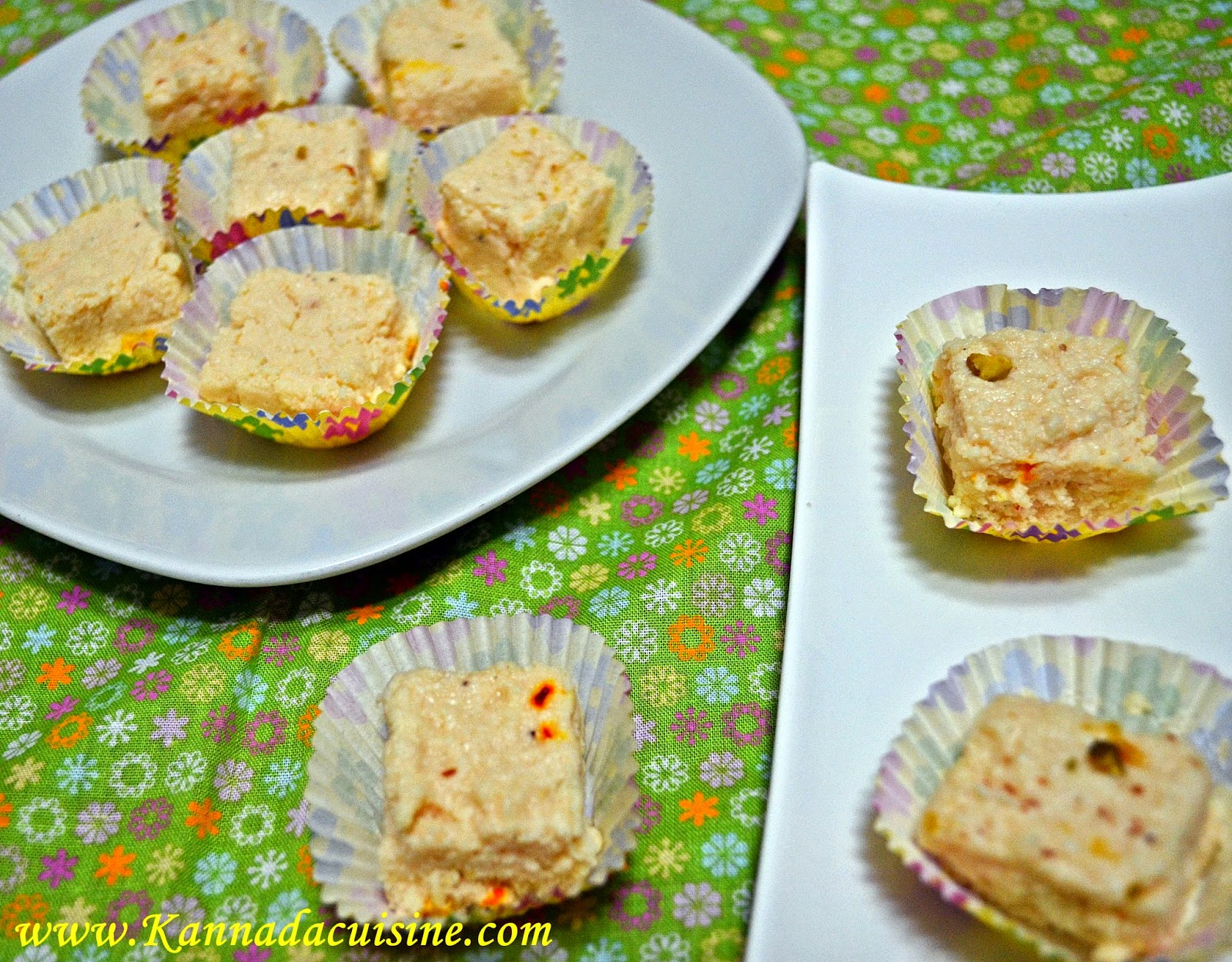
Now for the Kalakand. Like the good Mysore pak, this mildly sweet, moist and milky goodie is a rarity. Cheaper imitations are found in plenty, the ones the smell like stale Khoa, the ones that are dry and crumbly. But the ones that moist, with just the right amount of sweetness is so hard to come by.  I made these during Navratri and they were very well received.

We will need,

Ricotta cheese  15 oz can
Condensed milk 7 oz (half a tin)
Cardamon 2 (seeds grounds and  the skin discarded)
Kesar a pinch
Milk 1 tbsp
Pista for garnish
Ghee a tsp

Method:
  • Pop the ricotta into the freezer for several hours and thaw it for a few hours on the counter top. (I do this to separate the milk solids from the whey)  
  • Line a sieve with a cheese cloth and dump the ricotta into  the sieve. Discard the whey and save the milk solids.
  • Warm the milk , stir in the saffron and set it aside. Grease a tray with ghee and set it aside.
  • Once the ricotta is drained well, combine it with the condensed milk  in a microwave proof bowl. 
  • Pop it in the microwave for 3-4 minutes on high. Remove and stir well, add the cardamon, saffron mixture and microwave it on high again for 2 minutes. Repeat this every minute or so keeping a close watch on the mixture, till it gets bubbly and leaves the side of the container.  It took me a total of 8 minutes. But the duration can change depending on the quantity, the moisture in the ricotta and also the power of the microwave oven.
  • Dump the mixture into the greased tray. Even out the mixture and sprinkle grated Pista on top. Refrigerate for two hours, remove and cut it into pieces


Quick Carrot Halwa

Wishing you all a happy Ayudha Pooja. Also spending a minute here to remember Gandhiji and Sastriji on their birth anniversaries as well.

It is poignant that the Prime Minister should be kicking off the Swacchata Andolan today. Cleanliness is all about attitude, much less about resources. During my younger days, in one of the several towns we lived , I had noticed something. It was summer and there was no piped water back then in the town. We all had to collect water from street side taps and store it so it lasts for 3-4 days. About half a kilometer from where we lived was the area where the 'Vadda's a Dalit subgroup lived. We used to pass the 'Vaddara Hatti' as the area was called sometimes. They did not have street side taps, probably they got all the water from one of the wells in the area. Their houses were small compared to our own but their yard relatively big and very well maintained. The yards would be plastered using cow dung  which was a common practice back then to keep away the wild dusty earth a little more tame. Also part of the year were beautiful Rangolis which were drawn when the cow dung plastering was  moist so that the Rangolies lasted a little longer. Such yards were extensions of the tiny houses. Women sat in the yards doing various chores, kids played around, they also combed their hair, did a lot of routine activities in the yard.  The point is that particular area was much cleaner than our own area where the houses were bigger. It was about attitude and need than resources. How do change attitude is the question.

For now it is a quick Carrot halwa. I made this as an offering on one of these days. It was quick for a week day and much lighter than the regular fare. So here it is.

We will need,

Carrots grated 2 cups
Condensed milk 1/4 cup
Ghee 2-3 tbsp
Almonds  4-5 chopped
Raisins a handful

Method:
  • Heat ghee in a skillet. Throw in the almonds and the raisins. once they are golden brown remove them one to a plate using slotted spoon. 
  • Throw in the carrots and saute till the moisture is gone and the carrots are fragrant about 8-10 minutes.
  • Pour in the condensed milk stir and cook till the carrots are soft. 
  • Fold in the almonds and raisins. Serve at room warm or at room temperature or chilled.

Rice Badam Kheer

Dasara is such exciting time. Celebrated all across India, various traditions are popular in various parts of the country. Mysore Dasara for me is synonymous with crowded Mysore, the time my father planned carefully to get us out of the city while the tourists flocked to see the spectacular Jambosavari. My memory of the only time I went to see the Jambosavari is perched up on someone's shoulder (most likely our then maid servant ) trying to make sense beyond the sea of people. I do not think I got a single glimpse of Drona or his Howda. Nothing short of a VIP pass would make Jambosavari an enjoyable experience. I consoled myself that in the absence of VIP passes, Drona looked majestic on Doordarshan with all its "Rukaavat Ke Liye Khedh Hai"!!
Apart from the Jambosavari which is indeed a culmination of the ten days long celebration, there is the Palace illumination, Exhibition, Kacheri aka concerts, flower show ,Khusti -wrestling matches in the arena near the palace and the most recent addition 'Ahara Mela' the food show. We lived a stones throw away from Mysore palace and could see the Palace illumination from our terrace. We could occasionally hear the Kacheri if it was not drown down by the 'Mikasura' - huge stereos playing Sandalwood songs from the Exhibition grounds.

On a sad note, I do remember Drona 26 years after he passed away. Peace to Drona once again. Having seen Dasara elephants closely as they lumbered on early each morning during their stay in the Palace, to Karangikere right by our doorstep, they have a special place in my heart. Hearing the tinkle of their bells, we would run out with occasional bananas or mostly a handful of grass and leaves to feed the Jumbos. Perhaps to the Jumbos we were like little curios, with an occasional surprise. What ever they thought of us, we loved those gentle giants. So here it is Rice and Badam Kheer, celebrating Mysore Dasara and the Dasara Aane/elephants.


We will need,

Rice 1/4 cup
Almonds 1/4 cup
Milk 2 cups
Evaporated milk 1 cup
Condensed milk 1/2 cup (+2-3 tbsp as per taste)
Saffron a pinch
Pista for garnish (optional)

Method:
  • Soak the almonds in warm water for a few hours. Peel the almond and discard the skin. Combine it with 1/4 cup of milk and grind it into a paste.
  • Remove 2 tbsp of milk into a separate container and stir in the saffron. Keep aside.
  • Combine the remaining milk and rice and cook till the rice falls apart. Keep stirring the mixture so that the mixture does not burn. 
  • Once the rice is completely done, stir in the almond mixture,evaporated milk and condensed milk. keep stirring till the mixture thickens and changes color.
  • Stir in the saffron and bring it to one gentle boil while stirring the mixture. Remove from heat.
  • Pop the Kheer into the refrigerator and serve chilled.

Kunda

Wishing all my readers a very happy Navratri. Dasara is in full swing here. It is already the sixth day! We feast-ers cannot believe how fast the last six days have passed. For fast-ers I know a few more days to go. I was toying with the idea of fasting sometime during Navratri. But ours is Mysore style feasting Dasara and I always guiltlessly adopt the more convenient of traditions. So it has been sweet naivedya for the Bombe Habba here. I will be covering the offerings made on all the ten days. The idea was to post the recipe the same day I make it. But that proved to be too ambitious. So here it is, a lagged coverage of Dasara, Kannada Cuisine style.

This time around, it is getting rather difficult to make elaborate recipes the first thing in the morning. Though always a from-the-scratch home made  kind of girl, this time I have made it a little easy on me. So this series will see a lot of made in the microwave recipes.

Kunda is rich, caramelized, condensed milk  un-apologetically rich but just sweet enough to bring out all the goodness of the fatty milk but never too sweet that you feel like you are swimming in a barrel of sugarcane juice. That dubious distinction will go to our Payasas... Kunda is delicate and rustic but comforting and proven to lift me up on those blue days.

We will need,

Dry Mawa/ milk powder 1/2 cup
Condensed milk  1/3 cup
Evaporated milk  1/4 cup
Butter melted 3 tbsp

Method:
  • Combine all the ingredients in a microwave proof bowl.
  • Pop the mixture into the microwave for 2 minutes. Remove and stir the mixture very well.
  • Pop the mixture again into the microwave for a minute more repeat the stirring part. 
  • Keep alternating between microwaving for a minute and stirring.
  • The mixture will start loosing moisture and the fat sort of separates slightly and the mixture will sort of turn golden brown as well. That is when the mixture is ready. At that point stop cooking it. Stir well and remove to a cool platter. Serve at room temperature.

Pine nut Peda

As I have mentioned many a times in my previous posts, this is my favorite time of the year. No wonder I go crazy on and off starting the month of Sravana all the way up to Diwali to New year. (That is pretty much half the year any way) I just need excuses to prepare, serve and eat something nice, mostly sweets.

To think of it, I never had a sweet tooth while growing up. My only weakness was for chocolate which any respectable kid back then would be fond of. Besides there was a scarcity value attached to chocolates be it Amul, be it Chadbury's. It was not like today, where kids just go and buy a bar of chocolate at a local Kirana store. We had to wait for days, months before we could get our bar of chocolate, mostly when one of my favorite uncles or my grandfather would visit us with the gift  of a bar. Most often than not, a single bar would be handed over to myself and my sister to share. I would eat mine up and wait for sister to save part of her's so that I could steal and eat it later when she was not around. I did that all the time. Most often my sister would not even remember the last few pieces that she had 'saved' in the fridge. When she did remember there would be a Mahabharatha -2 war unfolding in my own living room! I feel bad about it now. But as my Karma would have it , I am at the receiving end now. Honey steals and eats my share of 'nice' food before I realize it is gone.

My sweet tooth, I think I grew them when I was pregnant with Sunny boy. Somehow I did not crave for anything spicy at all through out my pregnancy. I was absolutely unable to tolerate chillies and ended up eating sweet-tart-mild Pulioggare by the tonnes. Normal times I would not even touch Pulioggare.  Pregnancy is indeed strange and makes you a stranger to your own self.

So to satisfy my sweet tooth, here are some Pedas I made using Pine nuts.  Pine nuts are very fatty and yummy. They make a perfect ingredient to make Pedas. These Pedas are great with kids, Sunny boy loved it and so did a few other kids, a perfect item for Dasara Bombe habba. So here it is the Pinenut Peda.


We will need,

Pine nuts 1 cup
Evaporated milk or regular milk 3/4 cup
Sugar 3/4 cup
Kewra a few drops
Rose Water a few drops
Cardamon 2 (seeds crushed and pod discarded)

Method:
  1. On a thick bottomed skillet, toast the Pinenuts till fragrant. Pine nuts are very fatty and sort to burn right away. So it is important to keep stirring them to get a nice golden color without burning them. Remove and spread out to cool on a cookie sheet.
  2. Once the nuts are cool, combine it with the milk/evaporated milk in a blender and blend till smooth.
  3. Pour the mixture into a thick bottom pan (I use a non-stick pan, just for sweets and prasadas)
  4. Stir in the sugar into the nut mixture and cook on a gentle heat stirring frequently.
  5. After about 25 minutes, the mixture will start coming together into a ball.
  6. Now fold into it the Kewra, rose water and cardamon powder. Mix very well and remove from heat. 
  7. Let the mixture cool down a bit and then pinch little ball the size of a small lime from the mixture and roll it between two palms of your hands. Flatten it slightly and stamp a desired design on the Pedas. 
  8. I just used my citrus zest peeler to sort of create a design on the Pedas. Let the Pedas cool and set before serving.

Seekarane / Sweetened Hung Yogurt

I love Krishna, as they  say, he is my 'Istha Deiva'. He might have been a historical person, a power broker, an astute politician we probably will never know. But to me he is that cherubic little kid who stole butter as well as hearts. What is there not to love in the little kid who did everything to bring the pot of butter down, especially if you have one such kid yourself!. He is worshiped as god, yet he is no human, so one among us, so close to heart. If he were ever a historical figure, it would be so difficult to objectively judge him, because of the personal bond that we share. We grew up hearing the stories of his naughtiness, kindness, bravery and everything else. So it is indeed very easy to fall in love with him.
So Janmastami happens to be special. It is after all the birthday of the little lovable imp. I try to fast during the day and prepare a lavish spread for the evening, but this time I could not really do that. Simple does not necessarily mean an ordinary affair. It had to be something special, something Krishna liked. So I decided to make Poori and Seekarane along with Bendekai gojju. After all Krishna was fond of milk, yogurt  and butter.

We will need,

Yogurt 3 cups
Milk 2 tbsp (warm)
Saffron 1 pinch
Sugar 1/4 to 1/2 cup adjust according to taste
Cardamon 1 pod, seeds crushed and pod discarded


Method:
  • Set a sieve over a smaller container. Line the sieve with a piece of muslin or cheese cloth. Pour the yogurt into the sieve, cover and keep it aside for a couple of hours in the refrigerator till the moisture in the yogurt is drained and a thick creamy solids are left in the sieve.
  • Crush the saffron and dump it into the warm milk. Let it sit for a few minutes.
  • Remove the hung curds into a mixing bowl and stir in the sugar. I used the super fine variety and it was a breeze to get it all mixed up. 
  • Throw in  the crushed cardamon and the saffron milk. Stir well to combine.
  • Chill it in the refrigerator for several hours for the flavors to develop and serve well chilled with Pooris.

Khoa Kobari Peda

Sunny boy started school today. My little baby rode on the school bus all by himself, I mean neither me nor Honey were with him. It was a mixed feeling. A was going through a gamut of emotions. My little baby did not need me as much as he did when he was say 2 years old. There is a degree of pride when I see him pick up his back ease his tiny feet into his shoes and walks to the door. At the same time, a part of me cries and cringes that my baby is now a boy, not the tiny little bundle in my arms that could stare into for hour. Like the little bird who has mastered the art of flying, he too one day will fly away from me in the quest for his life.

It is when I am under such emotional duress that my heart starts to ache, remembering people who never came back. It does not help that living here in NJ so close to New York city, September is a brutal month, at least the first two weeks are. Deliberate switching off the TV or avoiding the news papers, is not really enough to escape the 9-11 tragedy. It somehow hangs around like an apparition. The other day I saw this on the notice board of a local church "Grief Share starts Sep 10, 6 PM". For a moment I was wondering what it could be, before it hit me that it is September. And then there are the local memorials, which gets drenched in tears around this time of the year. Of course it is this time of the year that my eye start catching "We remember", " We will never forget.." and such. I do not know if my mind is unconsciously playing the trick or if it really happens at this of the year. No September 11 has been a normal day for me ever since I came to this country.  Somehow a tragedy of this extent feels way more painful here. May be it is the way they remember indeed. Many more people have died back home say due to natural calamities, insurgency and of course terrorism. They have all been equally painful, but grief is not public back home, it is personal, it is got nothing to do with our collect psyche as a society. But here it is a fully public grief share and re-living the memories of those who never came back on a very typical balmy feeling summer day. We have friends who worked there but were caught in the traffic jam and thankfully never made it to their office. We know of people who were in the building a few hours before the incident happened and could not believe what happened a few hours, minutes after they left. We know people who worked there, safely made it out  even as the building smouldered on at the top and never had the nerve to go back to the highrises of the city. All these somehow hits so hard.
On the contrary the Mumbai terror attacks have all but forgotten. I remember what I was doing as the tragedy unfolded, just like I remember that day when I heard what happened in NYC on that fateful day. Perhaps we all do. You cannot  forget the moment something so disturbing happens. But Mumbai terror attacks were soon forgotten. We do not remember the victims any more. All I can see is may be a small article in  some news paper. No public grief share, no public tribute  and not much impact on the collective Psyche of the city. I do salute the resilience of the city, it is perhaps a different way of coping up with a tragedy like that, to move on.
The difference how it is treated here and back home are however very stark. Ultimately, why it happened does not matter. All that matters is that people never came back because of  some one amongst us was crazy.
After all this let us go back to Khoa Kobari Peda, a nice tribute to all our dear departed as well as our Pitru's (ancestors). The timing could not have been right 9-11 and Pitrupaksha coinciding.

We will need,

Khoa (the moist variety ) grated 1 cup
Sugar 1/2-3/4 cup
Evaporated milk 1 can (the small one)
Kopra /dessicated coconut 1/4 cup
Ghee 2 tbsp

Method:
  • On a hot skillet, toast the dessicated coconut till the coconut is slightly golden and aromatic. Remove it on to a cool plate and set it aside.
  • Heat ghee in a thick bottomed pan. Throw in the Khoa. Keep stirring till it changes colour to slightly golden. This takes a while.
  • Pour in the evaporated milk and sugar. Cook till the sugar is well incorporated and the mixture comes together into a ball.
  • Remove from heat. Once it is cool enough to handle, pinch lime sized balls of the khoa mixture and roll it in the toasted coconut mixture. 
  • Set the coconut coated khoa balls in a tray and air dry for a few hours till the Pedas harden slightly. serve at room temperature.

Uddina Kaalu Tovve /Kaali daal/Maa ki dal

When I read about people protesting globalization at WTO and other events I smile! They do have legitimate concerns, agreed and their concerns need to be addressed too. But the militant types really baffle me. All right corporate expansion, profit mongering is one side of globalization, but what about ideas? what about food? We Indian have always been at the forefront of global exchange of products, ideas and of course food for millenniums now. It was an accepted way of life to appreciate knowledge where ever it came from. It is just the past few centuries that we lost ourselves and we were so alien to what our forefathers saw millenniums ago. How many of us now know about pizza? what about Taco? Early in my childhood the only Pizza that was available in Mysore was in Krishna Bakery, Modern kids would not even recognize it as pizza. They would call it an unidentified object, circular in shape with some tomato Palya on top and mind you no sign of cheese (even if it did, it was not immediately recognizable) But today every single kid knows Pizza and the intricate differences between the various styles, just like they know their Dosa.  Tacos! I had never heard of them as a kid. I had read in Tinkle Digest that in Mexico they make unleavened bread like our Rotis called Tortilla but Taco sounded more like gibberish. Now every one knows about Taco. Pasta, Cal-zone,  fried chicken, noodles etc etc the list goes on. We have incorporated so many foreign foods and made it our own. This is indeed the best part of globalization. We incorporate new ideas while making it our own. Though I cannot but look at the irony when I shopping at a local Patel store in New Jersey almost always end up picking up Sujata brand wheat flour, made by the 'Evil' General Mills head quartered somewhere in the American heart land, in the wheat basins of India and sent to this side of Atlantic in huge container ships! I click my tongue and say "Ah! globalization".

When I see this side of the coin clearly, I end up appreciating the other side of the coin better. We do learn new things but we are equally good at retaining part of our old established knowledge. For instance  whole urad dal is one of the native crops in India. It has been mentioned in ancient Kannada texts and has been used to make Idlis for more than a 1000 years now! So we have indeed retained and refined older knowledge to this day. Though I rather cannot imagine following the original known recipe for Idli, soaking whole Urad in buttermilk, grinding, fermenting, seasoning and steaming it as Idli. The end product looking rather dark grey and definitely not as light and fluffy as their modern counterparts.  So being one of the oldest pantry ingredient it is therefore not surprising that Urad dal finds it's way into a lot of yummy dishes, including this simple rendering.

This is a simple dal. The Urad dal when cooked till it falls apart makes this dish very earthy, hardy and festive. I love it. So here is Maa ki dal

We will need,

Whole Urad dal 1/3 cup
Rajma (optional) a handful
Ginger 1/2" +1 "
Hing a dash

For the Oggarane
Ghee 2 tbsp
Mustard seeds 1/4 tsp
Jeera 1/2 tsp
Fennel 1/4 tsp
Garlic 4 cloves

Onion 1 small chopped
Chilly powder 1 tsp (adjust according to taste)
Turmeric 1/4 tsp
Dhania powder 1/2 tsp
Tomatoes 3-4 chopped
Salt to taste
Coriander chopped

Method:
  • Pick and clean the Urad and Rajma(if using) and wash it with several changes of water. Soak it in generous quantity of water overnight.
  • Drain the dal and wash it again in several changes of water. Throw it in a pressure cooker along with 3 cups of water, 1/2" ginger (slightly crushed) and hing. Cook till the urad dal falls apart. (about 3-4 whistles in my pressure cooker). Remove from heat.
  • Prepare the Oggarane. Heat the ghee in a wok and throw in the mustard seeds, Jeera and fennel. Once they stop sizzling throw in the onion. Saute till the onions are translucent. 
  • Coarsely crush the remaining ginger and garlic and throw into along with the onions. Saute for a brief minute. Throw in all the spice powers and  the tomatoes. 
  • Cook the mixture till tomatoes turn pulpy. Remove from heat.
  • Once the pressure cooker is cool enough to handle, combine the cooked dal mixture and the onion mixture. Heat the mixture, adjust salt and  add the fresh coriander. Add more lemon juice if the dish is not tart enough.
  • Serve hot with rice.


Tondekayi Flaxseeds fry

Typically I do not buy into food fads. I sort of always rely on age old wisdom than the pop-researches published by glossy magazines. That is the reason flax seeds never charmed me till now. I finally decided to try them succumbing to heard mentality I guess. They did look rather sad for a miracle food. But then appearance is always deceptive. I went ahead and tried them. Initially I thought I would substitute them in our recipes calling for oil-seeds like peanuts or sesame. It is easy to begin with substituting for ingredients in the same family when experimenting  it the first time!

This Tondekayi fry turned out to be quite nice and I did not have to sell the idea of eating 'healthful' food to Honey. The health benefits of flax seeds, not sure as of now!

We will need,

For the masala

Flaxseeds 1 tbsp
Dhania seeds 1 tsp
Byadagi chillies 2-3 (Adjust according to taste)
Urad dal 1 tsp

For the fry
Tondekayi /Tindora 1 lb  cleaned, trimmed and cut into quarters
Peanut oil /coconut oil 1-2 tbsp
Mustard seeds 1/6 tsp
Jeera 1/4 tsp
Hing
Curry leaves a handful
Tamarind extract 1/2 tsp (adjust as per taste)
Jaggery crushed 1 tsp
Salt to taste
Coriander fresh to garnish

Method:
  • To prepare the masala, toast all the ingredients on a hot skillet one by one till golden brown and cool it. Once cool enough to handle blitz it in a grinder to end up with a smooth power.
  • Heat oil in a wok. Throw in the mustard, cumin, hing and curry leaves. Once they stop sizzling add the prepped vegetable. Saute till they are slightly tender about 5-6 minutes. Alternately it can be braised with a little water too.
  • Add the prepared Masala,tamarind, Jaggery and salt. Cover and cook till the vegetable is tender. Adjust salt and garnish with coriander. 
  • Serve hot with rotis.
 

Jalebi Revisited

It is my favorite time of the year! Sravana is here and the season of eating  has begin. We celebrated Varamahalaxmi habba last Friday.  Looking forward for Janmashtami this Weekend and Gowri-Ganesh soon after wards. So the season of eating has officially begin. With this comes a series of yummy goodies, sweets and all.

My love for Jalebi is legendary in my family circles!  I did win the Jalebi eating competition back in college, though it was not for quantity that I won, probably I would have won that too, but for eating a single Jalebi which was tied to a swinging sting overhead! So much so that my sister would spin the song "Love ke li ye saala kuch bhi karega" to "Jalebi ke li ye sala kuch bhi karega...".

After many attempts to make the perfect Jalebi, I think I m almost there. First I needed to list out the qualitites that makes a Jalebi good.

1. It must be crunchy
2. It must have  cavity inside to soak up the syrup and become juicy.

3. The sugar syrup should taste good with a hint of flavor.
4. Jalebi should stay crisp for a few days.
5. There should be just a hint of tartness.

The secret to making good Jalebis is fairly simple. Fermentation!
If we get to ferment our batter well, the Jalebis are a breeze to make.  The recipe is the same as was posted in my older post here.
But of course it is the fermentation in the process that made all the difference. This time around I sat the batter for one whole day instead of overnight. I could see the yeast action and small air bubbles in the batter before I started making the Jalebis. I reduced the amount of cornflour too, now I would say about 1/6 of a measure instead of 1/3 of a measure previously  noted in my recipe. I was happy with my results this time around.They were very good and disappeared in no time.

Some points to remember

1. Use organic cane sugar instead of the regular sugar (here in the USA). Indian sugar is just fine. The regular American sugar sort of leaves a chemical after taste which ruins the Jalebi. They work fine for cakes and Ladoos but a definite no no for Jalebi.

2. Always use Ghee in the fat used to deep fry the Jalebi. A few tables spoons of Ghee for a cup of refined oil will do too. But the flavour of ghee in the Jalebi takes it up a few notches.

3. To aid fermentation, I left the Yogurt on the counter top overnight so it is really tart to start with. This make the fermentation easy. I also added a teaspoon of sugar in my batter to kick start the fermentation.

4. The sugar syrup should be just about one thread consistency. Remove the sugar syrup to a cooler bowl once the desired consistency is achieved. Leaving in the same pot makes the syrup thicker and that makes it difficult for the Jalebis to absorb the syrup. Alternately stop shy of one thread consistency and the heat of the pot will help achieve the desired consistency.

5. Finally add a little flavoring to the syrup either saffron/ Elachi (i love) or a few drops of rose water (heavenly)

This one for more Jalebi making!! By the way I like mine one the golden side, it makes the Jalebi crisp and heavenly. So I made a few batches that were golden and a few that were not.


Omelette

There are few recipes I end up repeating many times a week. It is rather curious that I have never posted a few of those oft repeated recipes at all. Is it a case of familiarity breeds contempt? could be.  We as a family of three consume a dozen eggs in two - three weeks, mostly. I love eggs. They are my favorite breakfast. Eggs and a cup of milk, picked up during my hostel years at JNU. I hated the many different things that was served in the hostel. I hated the greasy Parathas, I hated the thick, heavy concrete circular slab called Uttapam, I hated the bland Upma and of course Tuesday was the day of fasting for Hanuman therefore we were served Bananas or eggs for breakfast. Since I did not like breakfast served on most of the days, I took to having egg and milk everyday since these were the constant alternate on the menu everyday.

Before my hostel days, we had tradition of bread and eggs for breakfast on Sundays. My mother used to prepare fresh butter on Sundays and me and my father would go to a small shop in Agrahara, Mysore to get our loaf of Modern sweet bread. Sometime, we would also pick up a small loaf of Modern fruit bread too. Then from Chick-Market  we would buy our eggs.  Back home my mother would prepare Omlette, french toast or boiled egg as per our choice. I would mostly stick to either Omlette or French Toast. My father would some times have it scrambled. Curiously enough Sunny boy loves eggs too. But he is a boiled egg whites only guy! Not like me who as a toddler used to drink my milk  beaten with raw egg, something of an eggnog (eeek.. I hate it now). My mother thought that would make me strong till some one told her that I could be food poisoned to death! So I actually do not remember what it tasted like though I survived the food poisoning scare. It is just that back then food was more wholesome and food poisoning was much lesser a scare then than now despite all our refrigeration and modern technology etc. Commercially farmed, processed and transported across half the globe food will never be as good as the locally grown fresh food.

For now it is just simple Omelet. Serve it for breakfast by itself or with a slice of bread. Or serve with for lunch dinner along with  Rice/Curry to make the meal a little more interesting. Also unlike the french Omelet which is served jiggly in the center we really cook the hell out of our eggs till they are golden brown. We make sure our Omelets never look like they were made out of eggs.  They should resemble the more familiar Dose to be good enough to be eaten! I know the French would probably cringe at our presentation, Julia Child might be rolling in her grave but then my Mother would never ever touch a completely yellow omelet, much less the jiggly ones. As a matter of fact, I would not either if I had a chance. Sorry IHOP I never liked your omelets or pancakes for that matter.

We will need,

Eggs 2
Onions 1 medium chopped
Green chillies 2 chopped (adjust according to taste)
Coriander a handful washed and chopped
Coconut fresh grated 1 tbsp
Peanut oil/Coconut oil 2 tsp
Salt and Pepper to taste.

Method:
  • Pre-heat a heavy bottom pan on medium high heat. 
  • Break the eggs into a bowl. Pierce the yolks and start whisking the egg. Whisk till frothy. 
  • Throw in all the ingredients and mix well.
  • Pour a tea spoon on oil into the pan and swirl the pan to ensure a thin film of oil all over the bottom of the pan. 
  • Gently pour the egg mixture into the pan and cook till the sides look set and golden brown.
  • Flip, pour the remaining oil around the edges of the pan and cook the other side for a few more minutes till the other side is golden brown too.
  • Serve hot.

Uppsaaru

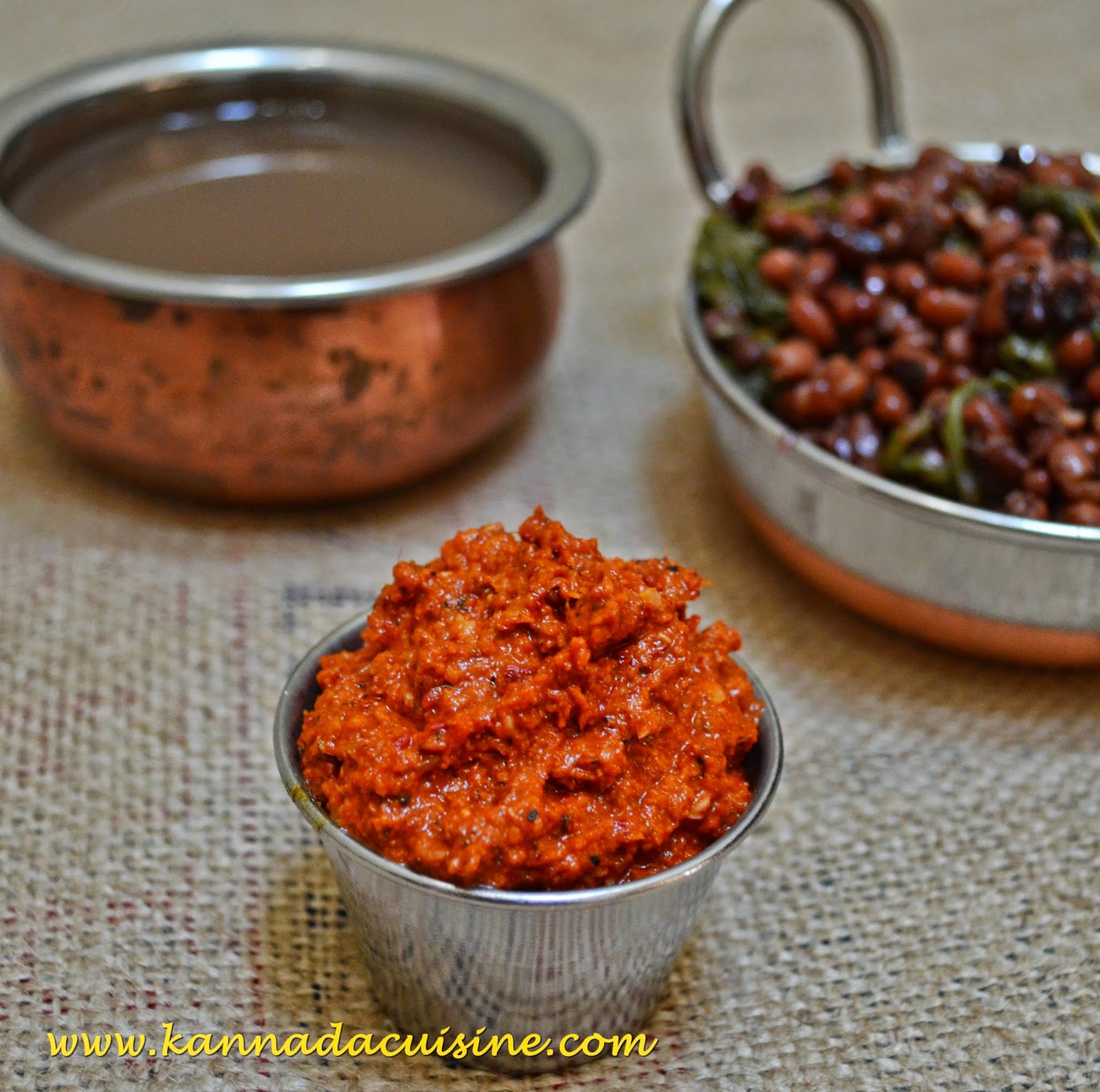
I have always believed that simplicity is the USP of Kannada cuisine which augers well for busy time constrained modern life. We have no time to cook elaborate meals now, looks like our ancestors did not have time for elaborate meals either. Our everyday meals are quick and easy with a sort of no-nonsense air about it. One such meal is Uppsaaru along with Ragi Mudde/Rice. Uppsaaru is just a handful of beans/legumes, vegetables, greens or any combination of the three cooked together and served with a side of "Khara" a spicy chutney made of red chillies and garlic.  A little more refinement means draining the cooked beans and vegetables reserving the stock. And then a quick Oggarane on the cooked beans/vegetable combo. How about this for a quick weeknight meal? Make the "Khara" once and Uppsaaru is ready in no time. In fact the Khara ground in a stone mortar/pestle would last for days without any refrigeration. That was how it was done indeed, kept in the empty shell of a coconut in open air.

There are three components to a more refined version of Uppsaaru, the Palya, the Kattu or the broth and the Khara, all served separately. As we ladle rice into our plates, we make a hole in the center and pour the Kattu into the hole. Then we throw a peanut size Khara and mix everything. We increase the heat by helping ourselves for more Khara if preferred.

So here it is. Simple food at its best.


For the Palya and Kattu,

We will need,

Beans/legumes of choice I have used Alasande (red chori) 1  cup
Mixed greens  1 lb or chopped vegetables (green beans, carrots, ridge gourd etc) 1 lb
or a combination of green and vegetables
Onion 1 large
Garlic 2 cloves minced
Red chillies 2 (broken)
Peanut oil/ghee 2 tsp
Mustard seeds 1/4 tsp
Jeera 1/2 tsp
Curry leaves a handful
Coconut fresh grated 1/4 cup (optional)
Salt and lemon juice to taste

Method:
  • Pick and wash the beans till water runs clear. Combine it with six cups of water in a pressure cook till al dente. 
  • Once the beans are cooked, throw in the greens/ vegetables and cook till vegetables are tender al dente.
  • Drain the vegetables in a colander and reserve the stock.
  • Heat oil/Ghee in a Kadai. Throw in the mustard seeds, Jeera, red chillies and curry leaves. When they crackle throw in the onions and the garlic. Saute till the onions are slightly pink. Throw in the well drained vegetable mixture.
  • Adjust salt and lemon juice. Throw in the coconut if using and remove from heat. 
  • For the Kattu, place the stock in a pot and adjust salt. Throw in a tea spoon of butter if preferred.  Serve the Palya and Kattu separately with the Khara as shown in the below picture

There are a bunch of recipes for Khara. It is nothing but one size fits all. I guess our grandmothers and their mothers were quite creative when it came to recipes like these. They just used what ever ingredient was handy, from coconut to garlic to peppers to toasted curry leaves.  Think of the recipe below as a starting point and customize is as desired. Most of the ingredients are optional except Red chillies, garlic, tamarind and salt.
We also make a green version of this Khara and call it Sapneeru.

We will need,

Byadagi chillies 10-15
Garlic 4 cloves
Pepper corn 2 tsp
Jeera 2 tsp
Tamarind extract 1/2 tsp
Jaggery 1 tsp
Kopra /dry coconut 1 tbsp
Salt to taste

Method:
  • Combine all the ingredients in a blender with as little water as possible and grind it to a smooth paste. Better it grind it in a granite mortar/pestle
  • Keeps well for at least two weeks in the refrigerator.