Vegetable / Panner Biriyani

I love Fridays. Something magical about not having to prep break fast the following morning, wake up early morning the next day and pack lunch box etc etc. The very thought of not having to do all that means its a Friday. So Fridays put me in the mood to make something luxurious but not too laborious. What better than Biriyani! We love it so much that two of us end up finishing a potful meant for four! I keep kidding Honey that the minute we see Biriyani, the flexible sack our stomach is, grows bottomless.

We will need, (yields 2 servings)

Basmati rice  3/4 C
Onion      1 medium chopped
Fresh Mint / Fenugreek   1 generous cup
Tomato   1 medium chopped
Green chillies   3-4 slit
Red chilly powder 1 tsp
Dhania 1 tbsp
Cloves  4
Cinnamon 1/2 "
Garlic 3 cloves
Ginger 1/2 " piece
Ghee  3 tbsp
coriander chopped 
Choice of mixed vegetable, panner  -1- 2 cups  (I prefer 2 cups, but not many people like vegetables in every spoon of biriyani)


For the oggarane:
Fennel Seeds   1/2 tsp
Jeera 1/2 tsp
Mint leaves a handful
Cardamon  3-4
Marat Moggu 2-3
Star Anise 2
Kalhuvu  ( I do not know what it is called in English it is kind of a fungus) a small piece
Bay leaf 1


Method:
  • Wash rice in multiple change of water, drain and soak it in 2 cups of water. Set it aside for at least 20 minutes.
  • Combine red chilly powder, Dhania powder, cloves  cinnamon garlic ginger and coriander in a food processor and pulse till smooth. Set it aside.
     
  • Heat ghee in a Handi or a thick bottomed pot. Throw in all the ingredients listed under Oggarane.
  • Once the spices sizzle and are fragrant,throw in the onions, fresh mint/ fenugreek and green chillies. Saute till the onions are golden
  • Throw in the tomatoes and cook till tomatoes are mushy and oil separates from the mixture.
  • Stir in the ginger-garlic spice paste.Cook on low flame till the mixture is fragrant and oil separates from the mixture.
  • Now stir in the other vegetables and cook for scant minute or two. Pour about 1.5 to 2 cups of water depending on the quality of rice. Increase heat and bring the mixture to a boil. Adjust salt and add lemon juice. 
  • Drain the rice and gently add the rice to the vegetable mixture. Stir gently for a brief second. Cover and cook till the rice is done about 20 minutes.
  • If using panner, open the rice mixture 15 minutes through the cooking.Toss the panner and cook the last 5-10 minutes on low heat

Shavige Payasa and Ugadi 2011

Ugadi 2011 was good. After a long long time, we had been to the temple on Ugadi had the 'Bevu-Bella' prasada there.  The cherry on the pie was the nice weather. So got to wear nice silk Saree and my little one got to wear his new Sherwani!
Food wise it was a toned down affair. We just had Carrot Palya, Beans Palya, sprouted Moon beans Kosambari, Chitranna, Payasa, Tovve and Tili Saaru...


Here is the recipe for Shavige Payasa...


Shavige /Vermicelli   1/4 Cup
Whole Milk    3 Cups
Ghee     2 tsp
Raisins  a handful
Cashews a handful
Saffron   a pinch
Cardamon 1/2 a pod
Sugar 1/4 cup  - more or less depending on your taste  (I used sugar on the raw)

Method:
  •  Heat a teaspoon of ghee in a non-stick pot. Throw in the Vermicelli. Toast till golden.Set it aside. 
  • Warm 1/4 cup of milk, throw in the saffron and let it soak for a while. 
  • Once the vermicelli is slightly cooler, pour in the warm milk. Stir and set it on low flame. Stir frequently making sure the creamy film does not form on top.
  • Once the milk is creamy and the Payasa is thicker, stir in the saffron, sugar and crushed cardamon. 
  • Simmer till the Payasa is thick almost reduce to about 1.5 cups. Turn off the heat. Serve it at room temperature or chilled.
 

Kargalu

Winters in Karnataka is always mild. We have never seen a bone chilling winter! A shawl, a sweater or say a monkey cap is all we needed if we had get out early in the morning to fetch milk or something like that. My mother for instance never even owned a sweater till my father was posted to Northern part of the country where it does get a little colder. But that does not mean we southern Kannadigas don't have specialty winter time snacks! By all means we do.
Right around Sankranti, when the air is still nippy and the first rays of sun warms up your toes like a cup of hot filter coffee would, we make this deliciously crazy snack ...'Kargalu'. Its literal meaning is Kari + Kalu - Deep fry + beans. We love it and god has endowed us the potential to demolish bowls after bowls of Kargalu. My grand mother always used to make it. She does not any more. It is too taxing on her aging body. But MIL still makes it. And I am as happy as a lark.

We will need,

Avarekalu / Pappadi lilva/ Indian beans  - 1.5 cup
Roasted Peanuts   -hulled and split           1/2 -3/4 cup
Channa Dal                                              1/2 c
Dry red chillies  (Byadagi)                         2-3  
Curry leaves                                              a handful
Koshar Salt to taste
Chilly powder  to taste (optional)
Fresh ground black pepper to taste
Peanut Oil to deep fry

Method:
  • Soak the avarekalu in cold water over night or for at least 4-6 hours. Drain and squeeze the beans out of the skin. Spread it out on a cookie sheet and air dry for about an hour or so. 
  • Heat oil in a Kadai. Once the oil is hot and has ripples in it, lower a handful of beans into the hot oil using a slotted spoon. 
  • Fry till the blisters appears on the beans and it turns golden in colour. Remove and drain on paper towels. Stir in a pinch of salt while it is still hot, that way the salt sticks to the beans. Repeat till all the beans are used up.
  • Now heat a tbsp of oil in another Wok. Once hot throw in the red chillies and curry leaves. Once they stop sizzling throw in the Channa dal. Stir till the channa dal is fragrant and changes colour to a shade of golden yellow. Turn of the heat.
  • While the  wok is still hot,  throw in the peanuts, fried beans and toss it well. Add salt, chilly powder and ground pepper to taste and toss. Allow it to cool and store it in an air tight jar. It stores very well for a few weeks. But that is if you are not me :)

Goes out to Treat to eyes series 2 hosted by Rumana @ spice Ur Senses

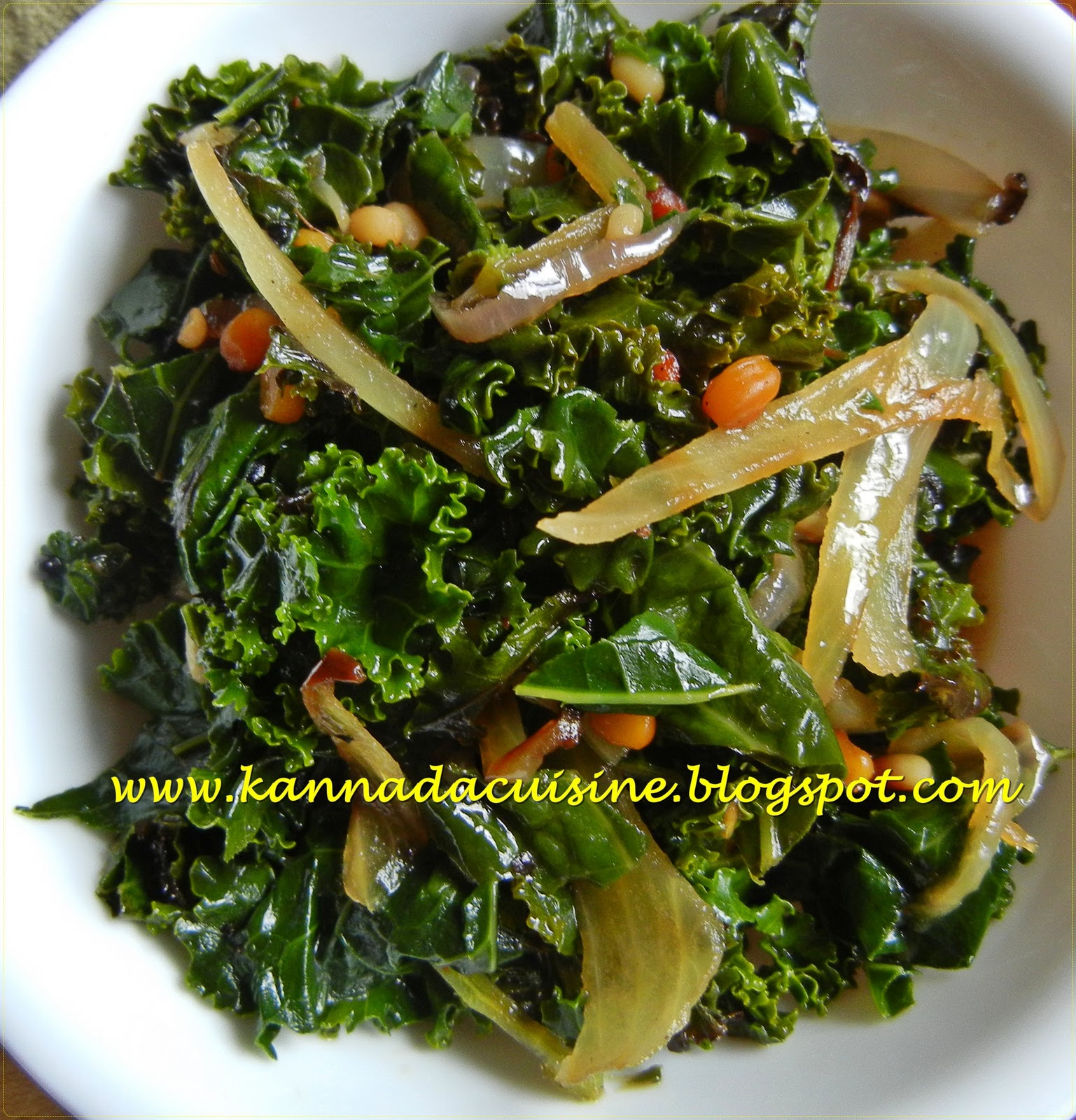
Kale Palya

Sugar free update: Well, Honey managed to stick to the sugar free diet for the past two weeks...Surprisingly he has lost 5.5 lbs... Yes! No exaggerations here. That was a pleasant surprise. Me :( There was this big bag of Snickers lying in the pantry from the last Halloween, I had to eat it. The craving used to strike me so hard and every time I walked past the pantry, i had to grab one. I finished the entire bag. Now, there is nothing much at home and hopefully I should go sugar free the next few weeks. In fact Honey's success is actually motivating me to go ahead in this direction.

So here is Kale from Suburban Organic It was fresh as it could be and gorgeous but Kale is not actually a familiar vegetable in my kitchen. Well what to do when you get something you have never tried before? Make a "Palya" out of it. We are a Palya loving family. So I went ahead with it.


We will need,

Kale 1/2 lb
Onion 1 big chopped into strips.
Dry red chillies / Bydagi 2-3
Expeller pressed Peanut oil 2 tsp
Mustard seeds 1/4 tsp
Jeera 1/2 tsp
Channa Dal 1 tsp
Urad Dal 1 tsp
Salt to taste
Hing a dash
Coconut grated 3-5 tbsp (Optional)

Method:
  • Wash and clean Kale and chop it into ribbons. Put the Kale in pot with about 1/2 cup of water. Blanch till the kale has soften a bit but still kind of al dente... We dont want our Kale to look limp and mushy. Drain and set it aside
  • Heat oil in a wok/ Kadai. Once hot, throw in the mustard seeds, Jeera, Hing,Channa dal, Urad Dal, Chillies in quick succession.
  • 10 seconds after adding the chillies, throw in the onions, cook till onions are transparent. Add the blanched Kale.
  • Stir adjust salt. Add the coconut if using. Cover and simmer for a few minutes. Remove from heat and serve hot.
Thank Leena for your cute award..

Kadalebeeja/ Shenga Unde Peanut clusters

Me and Honey have decided to go sugar-free for the next 2 may be 4 weeks. After reading so much about the effects of sugar on metabolism and after struggling to get back to pre-pregnancy weight both of us have decided to try going sugar free (for those of you wondering if a man puts on weight during his impending fatherhood- yes they do big time, in case of Honey almost as much as I did!). The only time we did eat sugar is on major festivals and that too in moderation. It has been three days and it looks like eternity. I never realized how much sugar we indeed consume on any given day. Shivratri was an occasion we had some sweets, a small Tambittu and a small Kadalebeeja Unde aka Shenga Unde. Sadly enough the next festival is so very far at Ugadi :(  I am so glad we cleared the biggest test. Last evening at a friends house we both refused Eclairs -the pillowy, chocolatey creamy eclairs.. Ah! we did it once and it sure feels good. Hope to keep on going.


We will need,

Peanuts  1 Cup
Jaggery   1/4  to 1/2 Cup  (I used about 1/4 )
Cardamon 2


Method
  • Preheat oven at 350 F. Spread the peanuts on a single layer on a cookie sheet. Pop the peanuts in the oven for about 10-15 minutes depending on your oven, till the peanut are fragrant and slightly deeper in colour. Remove and cool
  • Once the peanuts are cool enough to handle, spread them on a kitchen towel, cover it with another and rub it till the skin had fallen off the peanuts and they have broken into halves.
  • Combine the Jaggery and about 2 tbsp of water in a thick bottom pot. Melt the Jaggery and filter the syrup if you suspect any impurities in the Jaggery (I did not and went ahead with the recipe).
  • Crush the cardamon and toss it into the Jaggery. Bring the syrup to two thread consistency i.e. When you pinch the syrup between your wet thumb and forefinger, you can see at least two threads running between the fingers. 
  • Quickly stir in the peanut halves. Stir to coat the syrup onto the peanuts. 
  • Grease your palms and pat the peanuts into Ladoos, (The mixture will be crazy hot and it will scald) else, lift a little peanut mixture in a spoon and using another spoon, move the mixture on to a Parchment lined Baking sheet.
  • Cool it till the mixture sets and then store it in an airtight jar.

Fasting or feasting: Tambittu for Shivratri..

Happy Shivratri folks..
Shivratri is supposed to be a day of fasting. But in my family, we love to feast on Shivratri. My grandmother- Ajji makes loads of goodies for the occasion. Tambittu, Kodbale, Kadalebeja Unde aka peanut clusters..etc. Generally I stay away from making Tambittu, but starting this year I am planning to make it for the occasion: it is all about setting the tradition for my sunny little boy!!
I called up Ajji last night and jotted down the recipe. And here we are some constrained Tambittu. The constraint being my coffee grinder which did not grind the rice to my desired consistency, But taste wise no complaints.


Here are some from last year courtesy Susheela Aunty..


We will need

Raw rice  1 Cup
Jaggery   about 1/2 -3/4 cup
Roasted Peanuts  1/2 Cup
Roasted channa dal / Kadalepappu  3 tbsp
Toasted Sesame Seeds        1 tbsp
Copra/ Kobbari  3 tbsp chopped
Cardamon 3 pods, seeds crushed.

Method:
  • Heat a skillet and toast rice on it till the rice is fragrant and deep golden brown. Remove from heat and let it cool down.
  • Combine the Roasted peanuts, channa dal, sesame seeds and copra in a large mixing bowl. Set it aside.
  • Grind the cooled rice in a coffee grinder into a fine powder. The flour should resemble talcum powder.
  • Stir in the flour into the nut-seed mixture.
  • Heat the jaggery and a scant 1/4 cup water in a thick bottomed pot. Cook the mixture till the syrup reaches 'one thread' consistency i.e. you should be able to pinch the syrup between two wet fingers into a single thread.
  • Pour the syrup at the edge of the the nut-rice mixture a tablespoon at a time. stir the mixture little at a time. Press it between your palms to make Laddus. Rest it on greased cookie sheet till it sets- an hour or so.
  • Store in air tight box. It makes 5-6 lemon sized Tambittu.

Bananti -Post partum recipe

I have been getting mails from new mothers all over requesting Bananti recipes..I thought I should go ahead with the write up and not wait for the photos given the time sensitive nature for the request. I hope all the people who requested for such recipe read this post.

The basics are pretty clear. I mean traditional Bayaluseeme Karnataka style Banantana. I am mostly documenting the traditional wisdom of our folks that appears logical and has some scientific basis.

Consume a lot of protein :
  • Milk- preferably organic grass fed cow Milk (the corn fed cow milk is rather difficult to digest also GM-Soy-Corn in the feed makes me apprehensive. ) One of the better brands to look for is Organic Valley. 
  • Consume generous amounts of Ghee. Home made ghee using organic pasture butter is the best. Try getting Organic Valley  pasture butter and make your own ghee. If unavailable try their organic butter.
  • Avoid Eggs as it is an allergen.
  • Avoid most beans and legumes except Toor, Moong and Urad. The rest are hard to digest and may cause flatulence. Obviously new mothers are so much more prone to constipation, flatulence, we do not need to overburden her digestive system with food that can aggravate the situation.
  • Toor, Moong and Urad should be soaked in water for a few hours, drained and washed well then cooked till the grains fall apart, tempered with generous amounts of garlic and ghee before consuming.
  • Include plenty of greens especially Dill and Fenugreek greens. They are supposed to stimulate production of milk. 
  • Consume vegetables like carrots, green beans, beet root rich in nutrition. This indeed is a latest development. My grandmother says these vegetables were not a served during her time but she did give my mother a lot of these vegetables when my mother had me.I did say thumbs up for this rule.
  • Consume meat in moderate quantities if you are not a vegetarian.
  • Drink plenty of warm to hot water. 
  • Many women got back asking if wearing warm clothes and sweating is mandatory. I am not a medical professional but sweating does not convince me. Wearing warm clothes does make sense to me. Because our immune system is on the alert when our body temperature is higher and it sort of sleeps when body temperature is cooler. So to keep away from minor irritants like cold it is a good idea to wear warm clothes and keep indoors. This reduces the chance of  baby catching cold etc.
  • Also Sowbhagya Sunti Lehya is something many women consume. It might not agree with some women. So if this Lehya increases bleeding or gives cramps it is best not to consume it. 
  • On the Question of when to introduce cow's milk to your baby, I am pretty skeptical. As per the World Health Organization, breast feeding for at least two years is the best for baby (also the mother). But it might not work for every new mother. My pediatrician has suggested I start cow's milk after Sunny boy's first birthday. I held out a little longer. But when I did introduce cow's milk, Sunny boy had very bad episodes of constipation. Finally I switched over to raw pastured milk which I gently heated till cream formed on top, cooled it slightly and gave it to him. He tolerated it better than the homogenized milk. I would not consume homogenized milk much less give it to my baby.
Sample Menu:

  • Pre- Breakfast : One Antinunde and one cup of Milk
  • Breakfast: Akki Dose  or Akki Tari Idli with Ghee and Heralikai uppinakai or Akkitari Uppittu
  • Mid morning: Apple/Mango or any sweet fruit except Banana, citrus and grapes. (I did still eat citrus but not banana and grapes)
  • Lunch: A tbsp of  rice, 1/2 tsp ghee and Bananti Pudi ;  or Menasina Saaru or Dal with rice, Carrot/Green Beans/ Beetroot Palya and a cup of Milk, 
  • Late Afternoon: Half a cup of Akki Payasa , Gattaki Payasa, Halkeer , Belladanna or any Kheer /Payasa and a fruit.
  • Dinner:  A tbsp of  rice, 1/2 tsp ghee and Bananti Pudi ; fenugreek/dill/Chayote squash/ green beans dal   or Menasina Saaru  with rice, Carrot/Green Beans/ Beetroot Palya and a cup of Milk.
  • Drink warm to hot water, about 10 or more glasses a day. 
  • Munch on almonds and raisins if you are a grazer like me.

Akki Dose:

Mix 1/4 cup of Rice flour in about 1/4- 1/2 cup water to make a runny batter. Pour it over a hot skillet and cook till the sides are golden in colour. Remove and serve hot with Heralikai uppinakai and Ghee

Rave Idli

The umpteen Darshinis that populate every single street corner in Bangalore will have a few common favorites on their menu.  Undisputed King according to me is the Masale Dose. Honey contests it- dip-Idli means Idli dipped in a bowl of steaming hot Sambar or Chutney gets his vote. MIL on the other hand goes with Rave Idli. I have never seen her order something else! I for one will never change my loyalty to beloved Masale Dose. Every time we visit Darshini I keep thinking aloud ..may be Rave Idli or say Kharabath but at the counter the magic spell takes over and I feel partially tongue-tied ; one that makes me say 'ondu Masale Dose Kodi'...and nothing else. That is my fondness for Masale Dose.
However the star of today's show is obviously Rave Idli. So let us hear about Rave idli.

Apparently Rave Idli was born as an answer to war-time supply constrains. Wonder how legitimate the claim is but it is very much plausible. 


We will need, (makes 15-18 large sized Idlis )
 
Rave (Krishna Rave/ Uppittu Rave/Semolina)  2 Cups
Expeller Pressed Peanut oil       1 tbsp + More to grease the Idli mould
Mustard seeds    1/2 tsp
Jeera 1 tsp
Urad Dal split   2 tbsp
Channa Dal split  2 tbsp
Cashew nuts 2 tbsp (optional -I do not like them in Rave Idli so I do not use them)
Curry leaves a handful
Hing a dash
Salt to taste
Carrot grated  1/2 -3/4 cup
Fresh Coriander  chopped about 1/4 cup
Baking Soda   1/4 tsp
Tart Yogurt thinned out with water or tart butter milk 4 cups

Method:
  • We will need to prepare the Rave first. Heat oil in a thick bottomed Kadai, throw in the mustard seeds, once it stops spluttering add the jeera, urad, channa and hing. Once they stop sizzling about 20 seconds throw in the shredded curry leaves. Reduce heat to low. 
  • Throw in the cashews if using. Saute till golden. Throw in the Rave. Keep it moving else it will burn easily.
  • Once the rave is fragrant and warmed through, remove it from heat. Cool completely before assembling the idlis.
  • Once the Rave is cool, stir in the grated carrot, coriander, soda and salt. Make a well in the centre of the rave mixture and pour in the yogurt/buttermilk. Fold it gently till everything is combined. Set it aside for at least 20 minutes. The Rave needs to absorb the moisture to be able to plump up while steaming.
  • Set up a Idli steamer, or bring about 2- 2 1/2 " water to boil in a Pressure Cooker. Add a tiny piece of tamarind to the water if you want cleaning up to be easy!!
  • Pour the idli batter into the greased Idli moulds and steam till the batter is completely set when poked with a wet finger. (Yes it is going to be very hot, keep a bowl of cold water at hand, just in case of scalding) about 12-15 minutes.
  • Remove the idlis using a spoon and serve it hot with Saagu.
According to Mom the spiced rave after cooling can be stored in glass jar for a few weeks. I do not recommend it for this recipe because the expeller pressed peanut oil might smell weird if stored for a while. I recommend using up the Rave at once. However if you need to make a big batch of Rave try using refined peanut oil instead.

    Vegan chilly Chicken -Karnataka style /Temphe Chilly

    I am not a very big fan of soy products..'soy milk', I did say eww...Soy cheese I did say 'no thank you'. I did rather have my cup of milk-milk or 'cheese-cheese'. Tofu is still fine, nothing can beat Panner. Will I ever be a vegan? I do not think so, give me my yogurt, give me my cheese and I am as happy as a lark.  So what about this Temphe?

    I have been reading about Temphe in most western vegetarian cook books. I was always curious to check it out. So a few months back we got a slab of Temphe. I did not do my home-work properly and replaced half the slab of Temphe in a recipe that called for Paneer..We all hated the Temphe then. It was absolutely tasteless and so much like eating a bitter cardboard. Even though first impulse was to trash it, I threw the remaining Temphe in the freezer after much deliberation.
    And then I came across a recipe that called for Temphe and the recipe also called for it to be deep fried the first thing! So be it. I said and bingo this is how it was. This dish was such a hit, we polished it off straight off the Kadai.
    My mother got me a Karnataka style Chilli Chicken recipe from her friend.. I substituted chicken with deep fried temphe. It was heavenly. Love it.


    We will need,
    Temphe 1/2 lb cup into strips.
    Expeller pressed peanut oil to deep fry + 4-5 tbsp
    Whole Red Chillies      4-5  (Byadagi variety prefered)
    Garlic                           2 cloves
    Ginger                          1/2 " piece
    Tamarind paste            1/2 teaspoon
    Salt to taste
    Fresh Coriander            a handful

    Method:
    • Bring 4-5 tbsp of water to a boil. Dump all the chillies and cover with a tight fitting lid. Set it aside.
    • Deep fry Temphe strips in hot oil till golden brown and crisp. Drain it on paper towels. 
    • Once all the Temphe is fried and good to go, start making the sauce. Grind the soaked chillies and the soaking liquid, garlic, ginger and tamarind into a smooth paste.
    • Heat 4-5 tbsp of oil in a Kadai. Pour the spice mixture into the hot gently and carefully. Stir well and simmer.Cook it till the raw smell of the garlic and tamarind disappears.About 10-15 minutes. The sauce by now should be fairly thick. Add salt to taste.
    • Toss in the fried Temphe and turn off the heat. Sprinkle some fresh coriander and serve immediately.
    If preferred substitute Chicken/ Mutton for Temphe.

    Pacchadi

    The other day I had prepared some Pacchadi to go along with a Pulao and ritualistically started clicking pictures. Honey noticed it and asked if it was for my blog. I said it was. His reaction was horror! 'What! you do not yet have Pacchadi on your blog?....' The silence hung so heavy as if i had invited people for dinner and sent them away hungry.

    Our salad marathon is still on. We are managing to eat more vegetables and hopefully from next week onwards more fruits too. Because we just signed up for a weekly home delivery of organic fruits here . Here is one more tradition salad that goes particularly well with Pulavs and are a must on festive meals in my family.


    We will need

    Cucumber diced about 3 cups
    Tomatoes diced  1 cup
    Onion       diced 1/4 cup
    Green chillies  2-3
    salt to taste
    Mint a handful
    Sugar a generous pinch
    Yogurt  1.5 Cups (use organic whole milk yogurt for best results)

    Method:
    • Place all the vegetables in a bowl. 
    • Beat the yogurt till smooth. Stir in the salt and sugar. Add a dash of freshly ground black pepper if you desire.
    • Just before serving toss the vegetables with the yogurt. 
    • Enjoy with rice dish of choice.

    Dear LG has passed on a meme.. here it goes..
    7 things you dont know about me..
    1) I love fragrant homestyle Ghee..I have at least 2 tbps every day..
    2)Decided to reduce sugar and sweets and not been successful ..had a huge chocolate chip cookie @Nestle toll house :(
    3)My little monster gives me a hard time...his likes and dislikes changes as much as BSE-SENSEX!!!
    4)I love organic dairy..organic milk, butter, cheese, cream etc etc..Organic valley is my favorite brand
    5)Fell in love with the expeller pressed peanut oil that has become available in our super markets.. reminds me so much of the good old days when oil meant peanut oil got from the local expeller...more on that story later.
    6) Right now thinking of one more huge double chocolate chunk cookie..
    7)Rooting for Steelers this super-bowl...

    Temphe with Punde Pale / Mutton with Punde Pale aka Gongura

    Our recent India visit meant a lot of good eating. My brother-in-law who disputes my argument that Karnataka is mostly known for its vegetarian cuisine treated us to this dish. My sister was a thorough vegetarian before her marriage and now she loves non-vegetarian. So, 'love' does change one's food preference :). My BIL, well I often refer to him as my cousin rather than the distant sounding 'BIL', has been very gracious sharing this recipe with me. He hails from Bellary which is in the northern part of Karnataka, so this recipe makes it even more exotic. Honey gorged on this one and called it manna from heaven. Despite repeated attempts I failed to eat.. i still feel vegetarian is the best. My sister's Toge+rice+ghee is the proof..Toge..That reminds me.. Got to get the recipe from her.

    Vegetarians, the Temphe version follows....

    Here it goes ...courtesy Sudhir my dear BIL..

    Pundee Pale (Gongura)     3 bunches 
    Chuke pale             1 Bunch (I cannot get a more familiar term for this..May be it is a regional specialty)
    Sabakshi pale (Dill leaves)      1 Bunch
    Green Chillies          7-9
    Mutton                  ½ Kg   (Temphe 1/2 lb will do cut into strips)
    Onion                    1 big
    Turmeric powder    ½ Spoon
    Salt                    to taste
    Expeller pressed Ground nut oil  3-4 tbsp
    Fresh ground Paste of coriander leaves, Garlic and ginger 3 tbsp


    METHOD:
    • Coarsely chop all the three leafy vegetables and dump it in a thick bottomed pot along with green chilles. Add a cup of water and cook on low flame. When the mixture is through cooked,  mash it using a { Dal gotni (device used to mash the dal)} a masher.
    • Take freshly cut mutton pieces in a vessel. Add oil, turmeric, sliced onion and Ginger-garlic-coriander masala. Cook on low for about 15 minutes (stir occasionally).
    • Add one glass of water (200 ml) and allow it to boil. Simmer and cook till the meat is tender. Add more water if all the water has evaporated and the meat is still tough.
    • Once the meat is cooked and tender, add the mashed paste of leafy vegetables. Simmer on low flame for 10 mins.
    • Serve it hot, goes well with plain rice and jawar rotis.
    Note; If the mutton in not tender and water is hard use raw or dried Papaya flowers and   pre cook mutton  oil, turmeric, sliced onion and Ginger-garlic-coriander paste with little water in a pressure cooker for 2 to 3 whistle.


    Vegetarian version with Temphe:

    Pundee Pale (Gongura)     3 bunches 
    Chuke pale             1 Bunch (I cannot get a more familiar term for this..May be it is a regional specialty)
    Sabakshi pale (Dill leaves)      1 Bunch
    Green Chillies          7-9
    Temphe                 1/4 Kg   ( cut into 1/4 " strips)
    Onion                    1 big
    Turmeric powder    ½ Spoon
    Salt                    to taste
    Expeller pressed Ground nut oil  3-4 tbsp  + oil for deep frying

    Method:
    • Deep fry the Temphe till it is golden in colour, remove from heat and drain on a paper towel.
    • Coarsely chop all the three leafy vegetables and dump it in a thick bottomed pot along with green chilles. Add a cup of water and cook on low flame. When the mixture is through cooked,  mash it using a { Dal gotni (device used to mash the dal)} a masher.
    • Heat oil in a thick bottomed pot throw in the turmeric, sliced onion and Ginger-garlic-coriander masala. Cook on low till fragrant about 15 minutes.
    • Stir in the mashed paste of leafy vegetables. Simmer on low flame for 15 minutes.
    • Toss in the fries Temphe. Mix gently. Bring it to gentle boil and turn off the heat.
    • Serve hot with Jowar roti..

    Hesaru Kaalu Kosambari / Sprouted Moong Salad

    Salad time here..Our salads traditionally are called Kosambari. Kosambari is a mixture of fresh vegetables, pulses and dressed with a touch of expeller pressed peanut oil, hing, mustard, green chillies, salt and lemon juice. 
    Some of the vegetables popular in Kosambaris include carrot, cucumber, kohlrabi, cabbage, radish, onions, tomatoes....

    We will need..

    Carrot       2 Cups grated
    Radish       1/4 cups
    Coconut  grated   1/4 cup
    Sprouted Moong/ Hesaru kaalu  2/4 Cup
    Green Chillies   minced to taste
    Lemon juice to taste
    Salt to taste
    Expeller pressed peanut oil 1 tsp
    Hing a pinch
    Mustard seeds 1/4 tsp
    Curry leaves  a handful

    Method:
    • Toss all the vegetables in a  big bowl.
    • Heat oil in a small wok. Once the oil is hot, throw in the hing and mustard. Once the mustard stops spluttering throw in the curry leaves. Remove from heat. 
    • Pour the seasoned oil on to the vegetables. Adjust salt, lemon juice and serve it immediately.

    Alasande Dantu Sapneeru/ Spicy broth and braised Greens and Black eyed Peas

    New Years usually starts with resolution to eat healthy, loose weight etc etc.. many a new years, many a heros, many villains, once a hero, now a villain example carbs- once a villain now a hero example fats! and so many researches, so many  fads later I have finally decided to go back to my ultimate comfort food, the food that my folks have been eating for generations and led a healthy life. May be the recipes that are traditional in my part of the world suits my genetic makeup the best. My great grandfather knew nothing of Atkins', Mediterranean diet or what the American Heart Association recommended.. but he did live a healthy life! So here, it is time to rewind and go back to our traditional recipes for at least four times a week and may be indulge in palate pleasing adventures the rest of the week.

    Sapneeru is a very healthy dish, made with practically any vegetable, any greens and any pulses. Slight variation is also called Upsaaru. I will post the recipe sometime later. Sapneeru is a peasant food. If we envisage the life back in time, folks in the plains of Karnataka gathered a handful of greens, a handful of pulses simmered them in earthen pots, drained the mixture reserving the broth. Prepared some Ragi mudde mixed it with the condiment called "Khara" and demolished their meals. Those who could afford would add a dollop of butter on top of the Mudde. That made up for the most balanced of meals. The "Khara" would be ground on granite mortar and kept in coconut shells in a cool place. Even without any refrigeration, it would last for a few days. How convenient it would be to come back home after a long day at the fields to eat such a meal? Should not food mean 'availability' and 'convenience'? though in modern context, 'availability' has a different connotation altogether! These days you cannot predict the vegetable in season if you depend on the 'availability' in super markets...

    Here is Sapneeru,
    Use any hardy greens of your choice, same with the black eyed peas. Substitute it with Moong dal, Moth Beans, Indian Beans/ Avarekalu etc..

    Serves 6 ||  Calories per serving (Kcl) | total 298| Protein 5.5 |  fat 5 || Fiber 10 gm |

    Alsande / Black eyed peas/ Red Chori  2 Cups
    Dantu Sappu / Red Spinach  2 Cups

    For the Khara:
    Green Chillies       5-6
    Cumin  1 tsp
    Pepper Corns  1 tsp
    Salt
    Garlic cloves   4
    Tamarind  (whole) about  2" piece
    Fresh Coriander  a handful

    For the palya:
    Expeller pressed peanut oil  1 tbsp
    Onion          chopped 1 medium
    Mustard seeds 1/4 tsp
    Dry Red Chillies like Byadagi  3-4
    Garlic            2 cloves
    Salt

    Method:
    • Pick and wash the peas in multiple changes of water. Pressure cook till soft and done. Else soak it for to hours and cook in a thick bottomed pot till tender.
    • Clean and chop the spinach, dump it in a microwave safe bowl. Sprinkle some water over it and pop it in the microwave for about 4-5 minutes till the greens are slightly wilted but still green and bright.  Else pop the chopped spinach with the boiling peas just five minutes before you take the peas off the heat.
    • Drain the peas and spinach and save the broth. 
    • Pulse all the ingredients for the "khara" in a blender with as little water possible; better yet crush it in a mortar-pestle till smooth. Set it aside.
    • For the Palya, heat oil in a wok. Tip in the mustard, chillies and garlic for a few seconds. Throw in the chopped onions. Once the onions are soft and translucent, throw in the cooked peas and spinach. Adjust salt and turn off the heat.
    • To serve, Pour the broth over a bed of rice, place a dollop of the "Khara" and vegetables on the side. or Serve it this way with Ragi Mudde! 

    Goes out my favorite event the MLLA @ Briciole brainchild of Susan